
Introduction
This document serves as a comprehensive instruction manual for the Craftsman Model 351.217120 Lathe. It provides essential information for the safe and efficient operation, maintenance, and troubleshooting of your machine. Please read this manual thoroughly before operating the lathe to ensure proper use and to prevent injury or damage.
This specific manual is a high-quality reprint, designed to provide the same critical information as the original owner's manual, ensuring you have all necessary guidance for your Craftsman lathe.
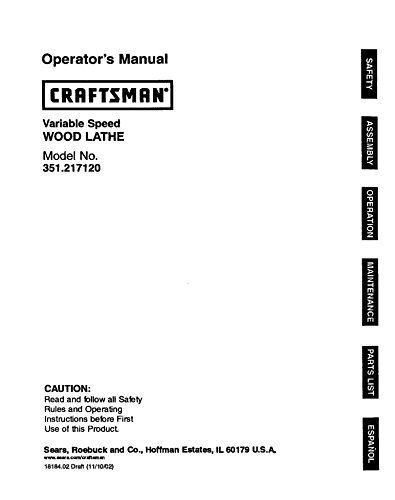
Image: Cover of the Craftsman 351.217120 Lathe Instruction Manual. This image displays the front cover of the manual, indicating the model number and brand.
Safety Instructions
WARNING: Failure to follow these safety instructions may result in serious personal injury or property damage.
- Always wear appropriate eye protection (safety glasses or face shield) when operating the lathe.
- Ensure the work area is clean, well-lit, and free from obstructions.
- Do not wear loose clothing, gloves, or jewelry that could become entangled in moving parts.
- Securely fasten all workpieces before starting the lathe.
- Never leave the lathe running unattended.
- Disconnect power before performing any maintenance, adjustments, or changing accessories.
- Keep hands clear of rotating parts.
- Use only accessories and attachments recommended by the manufacturer.
Setup
1. Unpacking and Inspection
Carefully remove all components from the packaging. Inspect for any shipping damage. Report any damage immediately to the carrier or retailer. Ensure all parts listed in the packing list are present.
2. Assembly (if required)
Follow the detailed assembly instructions provided in the original manual. Typically, this involves mounting the lathe to a sturdy workbench, attaching the motor, and installing any necessary guards or accessories. Ensure all fasteners are tightened securely.
3. Power Connection
Connect the lathe to a grounded electrical outlet of the correct voltage and amperage as specified on the motor nameplate. Do not use extension cords unless absolutely necessary, and if used, ensure they are rated for the required power.
Operating Instructions
1. Basic Controls
Familiarize yourself with the main power switch, emergency stop button, speed control knob/lever, and chuck/spindle lock. Understand their functions before starting any operation.
2. Mounting Workpieces
Select the appropriate chuck or faceplate for your workpiece. Ensure the workpiece is centered and securely clamped to prevent it from coming loose during operation. Use a live center in the tailstock for longer workpieces to provide additional support.
3. Setting Spindle Speed
Adjust the spindle speed according to the material being turned and the diameter of the workpiece. Generally, larger diameters and harder materials require slower speeds. Refer to the speed chart (if available on your machine) or consult general lathe operation guidelines.
4. Turning Operations
Position the cutting tool correctly, ensuring it is sharp and at the correct height relative to the workpiece center. Begin with light cuts and gradually increase depth as needed. Always feed the tool smoothly and consistently.
Maintenance
Regular maintenance ensures the longevity and safe operation of your Craftsman lathe.
1. Cleaning
After each use, clean the lathe thoroughly. Remove all chips, dust, and debris from the bed, carriage, and other moving parts. Use a brush or shop vacuum; do not use compressed air as it can embed chips into bearings or electrical components.
2. Lubrication
Periodically lubricate all moving parts, such as lead screws, gears, and slides, according to the manufacturer's recommendations. Use the specified type of oil or grease. Over-lubrication can attract dust and chips.
3. Adjustments
Check for and adjust any loose belts, gibs, or other components. Ensure the tailstock and headstock are properly aligned. Refer to the original manual for specific adjustment procedures.
Troubleshooting
This section addresses common issues you might encounter during the operation of your lathe.
| Problem | Possible Cause | Solution |
|---|---|---|
| Lathe does not start | No power, emergency stop engaged, faulty switch | Check power cord, reset emergency stop, inspect power switch |
| Excessive vibration | Unbalanced workpiece, loose mounting, dull cutting tool | Balance workpiece, tighten mounting bolts, sharpen/replace tool |
| Poor surface finish | Dull tool, incorrect speed/feed, excessive tool overhang | Sharpen tool, adjust speed/feed, reduce tool overhang |
Specifications
The following are general specifications for the Craftsman 351.217120 Lathe. For precise details, refer to the original manufacturer's documentation or the nameplate on your specific machine.
- Model: Craftsman 351.217120
- Type: Metalworking Lathe (assumed based on typical Craftsman lathe models)
- Power Requirements: Varies by motor, typically 110-120V AC, 60Hz
- Swing Over Bed: (Specific measurement would be here, e.g., 10 inches)
- Distance Between Centers: (Specific measurement would be here, e.g., 24 inches)
- Spindle Speeds: (Range of speeds would be here, e.g., 120 - 2000 RPM)
Warranty Information
This document is a reprint of the original instruction manual. Any warranty for the Craftsman 351.217120 Lathe would be provided by the original manufacturer (Craftsman) at the time of the lathe's purchase. This reprint does not provide or extend any warranty for the lathe itself. Please refer to your original purchase documentation for warranty details pertaining to the lathe.
Support
For technical support, parts, or service related to your Craftsman 351.217120 Lathe, please contact the original manufacturer or an authorized service center. As this is a reprint, direct support for the lathe itself is not provided by the publisher of this manual. You may find contact information on the original lathe or through historical Craftsman documentation.