1. Introduction
The ASUS Prime B250M-A is a Micro ATX motherboard designed to support 7th generation Intel Core processors. It features an LGA1151 socket, DDR4 memory support, and various connectivity options including HDMI, DVI, VGA, and dual M.2 slots. This manual provides essential information for the proper installation, configuration, and maintenance of your motherboard.
- Connectivity and Speed: Features integrated Dual M.2 slots with Intel Optane Memory compatibility and a rear USB 3.1 Type C connection.
- Hardware Safeguards: Equipped with 5X Protection III, providing hardware-level safeguards for component longevity and reliability. Includes ASUS LAN Guard and a Realtek RTL8111H Gigabit LAN Controller.
- Cooling Control: FanXpert 2 PLUS offers advanced fan control with an integrated AIO pump header for dynamic cooling.
- PCIe Slot Durability: Dual Patent-pending Safe Slot Core fortified PCIe slots prevent damage from heavyweight GPUs.
- Customization: On-board 3D-printing mounts allow for unique designs on your customized build.
2. Setup and Installation
Before beginning installation, ensure your system is powered off and disconnected from the power source. Handle the motherboard by its edges to avoid static discharge.
2.1. Package Contents
Verify that all items are present in your motherboard package:
- User's manual
- Serial ATA 6.0Gb/s cables (2)
- I/O Shield
- M.2 screws (2)
- Support DVD
2.2. Motherboard Layout
Familiarize yourself with the layout of the ASUS Prime B250M-A motherboard to identify key components and connectors.

Figure 1: Top-down view of the ASUS Prime B250M-A motherboard. This image displays the central LGA1151 CPU socket, four DDR4 RAM slots, multiple PCIe expansion slots, and various headers and connectors for power, storage, and peripherals.

Figure 2: Angled view of the ASUS Prime B250M-A motherboard. This perspective shows the rear I/O panel with its various ports, the CPU socket, RAM slots, and the layout of the PCIe slots and M.2 slots.
2.3. CPU Installation
Carefully open the LGA1151 socket lever, align the CPU with the triangular mark on the socket, and gently place it into the socket. Close the lever to secure the CPU. Refer to the CPU manufacturer's instructions for cooler installation.
2.4. RAM Installation
The motherboard supports up to 64GB of DDR4 memory at 2133 MHz across four DIMM slots. Open the clips on both ends of the DIMM slot, align the memory module with the slot key, and press down firmly until the clips snap into place.
2.5. M.2 SSD Installation
The motherboard features dual M.2 slots. Insert the M.2 SSD into the slot at an angle, then gently push it down and secure it with the provided M.2 screw. Note: If a SATA M.2 SSD is used, the first SATA port (SATA6G_1) may be disabled. Consult the detailed manual for specific slot configurations.
2.6. PCIe Card Installation
Insert your graphics card or other PCIe expansion cards into the appropriate PCIe slots. Ensure the card is fully seated and secured with a screw to the chassis. The Safe Slot Core design provides enhanced retention for heavy GPUs.
2.7. Power Connections
Connect the 24-pin ATX power connector from your power supply to the motherboard. For CPU power, connect the 4-pin CPU power connector. If your power supply has an 8-pin CPU power connector, it can be partially inserted into the 4-pin slot, ensuring the correct pins are aligned for power delivery.
2.8. Storage and I/O Connections
Connect SATA drives to the six SATA III 6.0Gb/s ports using the provided SATA cables. Install the I/O Shield into your chassis before mounting the motherboard. Connect front panel headers (USB, audio, power/reset switches, LEDs) according to the labels on the motherboard and your chassis manual.
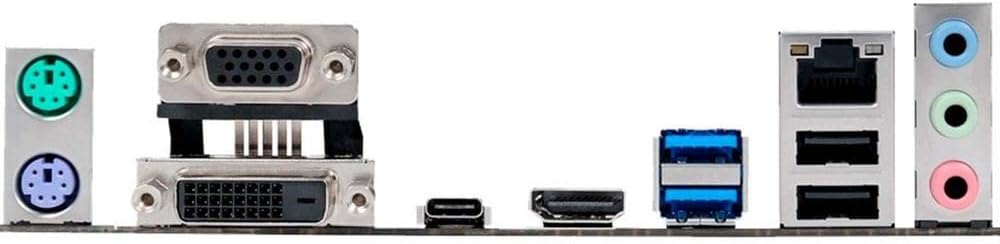
Figure 3: Rear I/O panel of the ASUS Prime B250M-A motherboard. This image details the available ports including PS/2 keyboard/mouse, VGA, DVI-D, HDMI, USB 2.0, USB 3.0, USB 3.1 Type-C, Gigabit LAN, and audio jacks.
3. Operating Instructions
After completing hardware installation, connect your display, keyboard, and mouse. Power on your system to begin the operating system installation process.
3.1. BIOS/UEFI Setup
Upon initial boot, press the DEL or F2 key to enter the UEFI BIOS Utility. The UEFI interface is designed for easy navigation, allowing you to configure boot options, system settings, and monitor hardware status. Save changes before exiting.
3.2. Driver Installation
Install necessary drivers from the included Support DVD or download the latest versions from the ASUS official website. This includes chipset drivers, LAN drivers, audio drivers, and graphics drivers for integrated or discrete GPUs.
3.3. Fan Control with FanXpert 2 PLUS
Utilize the FanXpert 2 PLUS software to customize fan speeds and profiles for optimal cooling and noise levels. This utility also supports control for AIO pump headers.
3.4. On-board Lighting
The motherboard features subtle orange LED lighting. This lighting can be configured in the BIOS to breathe or remain steadily lit. It will remain active as long as the power supply is on, even in sleep mode or when shut down, unless configured otherwise in the BIOS.
4. Maintenance
Regular maintenance helps ensure the longevity and stable operation of your motherboard and system.
4.1. Cleaning
Periodically clean dust from inside your computer case, especially around fans, heatsinks, and motherboard components. Use compressed air and ensure the system is powered off and unplugged before cleaning.
4.2. BIOS Updates
ASUS provides utilities for easy BIOS updates, often through software within the operating system or directly from the UEFI BIOS. Regularly check the ASUS support website for the latest BIOS versions to improve compatibility and performance. Follow update instructions carefully to avoid system instability.
4.3. Driver Updates
Keep your drivers updated by regularly checking the ASUS support website. Updated drivers can provide performance improvements, bug fixes, and enhanced compatibility with new hardware or software.
5. Troubleshooting
This section addresses common issues you might encounter during setup or operation.
5.1. System Does Not Power On
- Ensure all power cables (24-pin ATX and 4-pin CPU power) are securely connected to the motherboard.
- Verify that the power supply is switched on and connected to a working power outlet.
- Check front panel power switch connections to the motherboard.
5.2. No Display Output
- Confirm that your monitor is connected to the correct video output port (HDMI, DVI, or VGA) on the motherboard or discrete graphics card.
- Reseat the graphics card and memory modules.
- Try booting with only one RAM stick installed.
5.3. SATA M.2 SSD Disables SATA Port
If you install a SATA-based M.2 SSD, the SATA6G_1 port will be disabled. This is normal behavior. If you require all SATA ports, consider using a PCIe-based M.2 SSD or connecting your SATA drive to a different SATA port.
5.4. Windows 7 Installation Issues
Installing Windows 7 on this motherboard can be challenging due to driver compatibility with newer hardware. Specific requirements include using 6th generation CPUs and DDR4 2133MHz memory. ASUS provides a specific guide on their website for Windows 7 installation, which may require loading drivers during the OS setup process. It is recommended to use Windows 10 or later for optimal compatibility and driver support.
5.5. General Instability or Errors
- Ensure all components are properly seated (CPU, RAM, expansion cards).
- Check for bent pins in the CPU socket before CPU installation.
- Verify that your power supply provides sufficient wattage for all components.
- Update BIOS and drivers to the latest versions.
6. Specifications
Below are the key technical specifications for the ASUS Prime B250M-A motherboard.
| Feature | Specification |
|---|---|
| Brand | ASUS |
| Model Name | PRIME B250M-A |
| CPU Socket | LGA 1151 |
| Compatible Processors | 7th Generation Intel Core |
| Chipset Type | Intel B250 |
| RAM Memory Technology | DDR4 |
| Max RAM | 64 GB |
| Memory Clock Speed | 2133 MHz |
| Product Dimensions (LxWxH) | 10.24 x 2.03 x 10.63 inches |
| Item Weight | 10.7 ounces |
| USB 2.0 Ports | 2 (rear) + internal headers |
| USB 3.1 Type-C | 1 (rear) |
| Video Outputs | HDMI, DVI-D, VGA |
| LAN | Gigabit LAN (Realtek RTL8111H) |
| Storage | 6 x SATA 6Gb/s ports, 2 x M.2 Socket 3 |
7. Warranty Information
For detailed warranty information regarding your ASUS Prime B250M-A motherboard, please refer to the warranty card included in your product packaging or visit the official ASUS support website. Warranty terms and conditions may vary by region and retailer.
8. Support
If you encounter issues not covered in this manual or require further assistance, please utilize the following resources:
- ASUS Official Support Website: Visit www.asus.com/support/ for updated drivers, BIOS, utility software, FAQs, and detailed product manuals in PDF format.
- Included Support DVD: The product package includes a Support DVD with drivers and utilities.
- Technical Support: Contact ASUS technical support directly through their website for personalized assistance.


