
RoaringTop 80C 2200mAh 3S 11.1V
RoaringTop LiPo Battery Pack User Manual
Model: 80C 2200mAh 3S 11.1V
1. Introduction
Thank you for choosing the RoaringTop LiPo Battery Pack. This manual provides essential information for the safe and effective use, charging, and maintenance of your battery. Please read this manual thoroughly before using the product to ensure optimal performance and safety.
2. Safety Instructions
Lithium Polymer (LiPo) batteries are powerful and require careful handling. Failure to follow these safety instructions can result in fire, personal injury, and property damage. Always prioritize safety.
- Charging: Always use a LiPo-compatible charger with a balance function. Never charge unattended. Charge on a non-flammable surface away from combustible materials. Do not charge a damaged or swollen battery.
- Discharging: Do not over-discharge the battery. The voltage should not drop below 3.0V per cell (e.g., 9.0V for a 3S battery). Over-discharging can permanently damage the battery.
- Storage: Store LiPo batteries at room temperature (20-25°C or 68-77°F) and at a storage voltage of approximately 3.8V per cell. Keep away from direct sunlight, heat sources, and moisture.
- Handling: Do not puncture, disassemble, short-circuit, or expose the battery to extreme temperatures. Avoid dropping the battery. If the battery is damaged, stop using it immediately.
- Disposal: Dispose of LiPo batteries responsibly according to local regulations. Never dispose of them in regular trash.
- Supervision: Keep batteries out of reach of children and pets.
3. Product Overview
The RoaringTop LiPo Battery Pack is designed for high-performance RC applications, featuring premium-grade materials and advanced construction for reliability and power density.
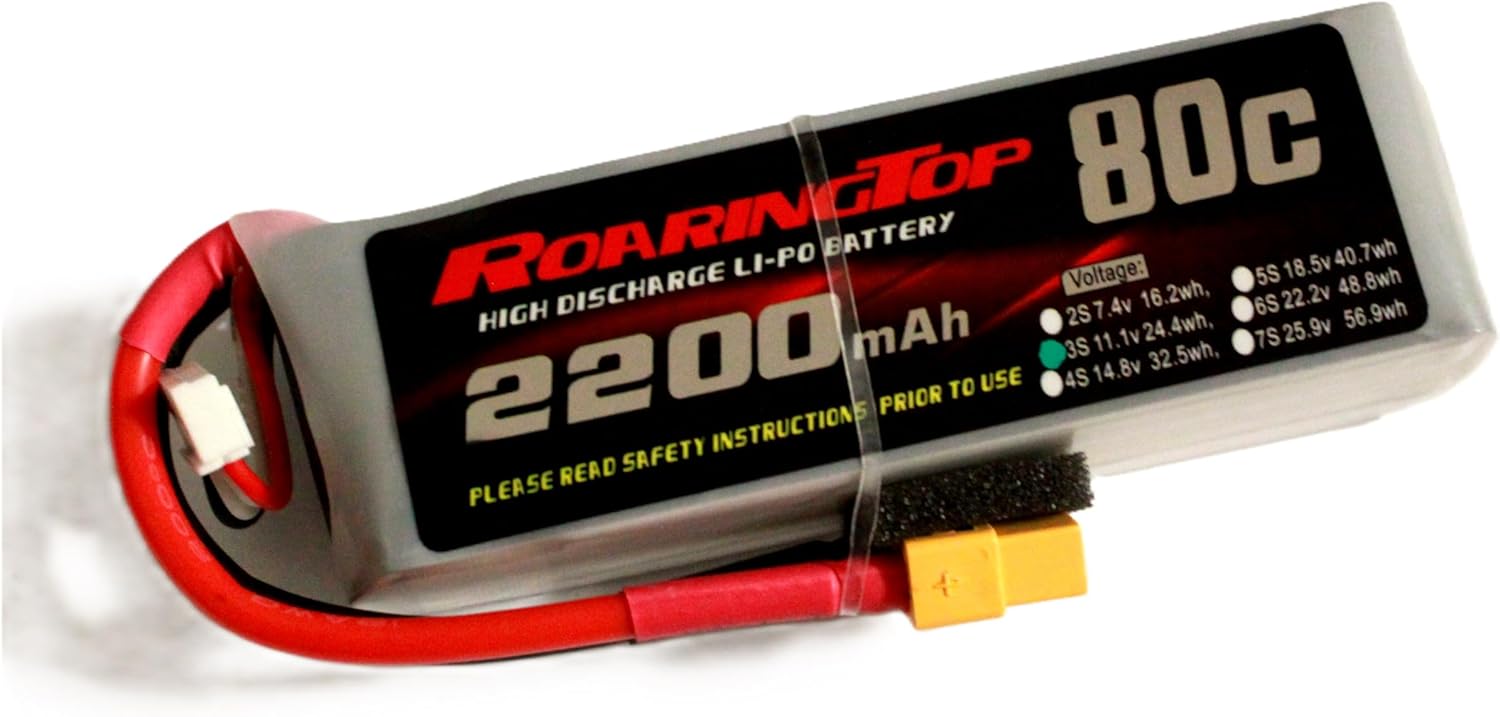
Figure 1: RoaringTop 80C 2200mAh 3S 11.1V LiPo Battery Pack. This image shows the grey battery pack with red wires, an XT60 discharge plug, and a white JST-XH balance plug. The label displays "RoaringTop HIGH DISCHARGE LI-PO BATTERY 2200mAh 80C" and voltage specifications for 2S to 7S configurations.
Key Features:
- Premium-grade material from Japan, patented electrolytes and ultrasonic welding ensures low-resistance, high-reliability and light-weight properties.
- High quality consistency, a lot of punch, power density up to 230Wh/kg, Longer cycle life compared with most standard batteries in the market.
- Ultra-high voltage under load, flat discharge curve, excellent performance at low temperature and high discharge rate.
4. Specifications
| Attribute | Value |
|---|---|
| Capacity | 2200 mAh |
| Voltage | 3S / 3 Cell / 11.1 V |
| Discharge Rate | 80C |
| Weight (including wire, plug & case) | 192 g |
| Dimensions (H x W x L) | 27 x 35 x 101 mm (1.06 x 1.38 x 3.98 inches) |
| Balance Plug | JST-XH |
| Discharge Plug | XT60 |
| Battery Cell Composition | Lithium Polymer |
| Recommended Uses | Remote Control Vehicle (Car, Boat, Truck, Heli, Airplane) |
5. Setup
Before first use, ensure your battery charger is compatible with LiPo batteries and has a balance charging function. Inspect the battery for any physical damage or swelling.
- Initial Inspection: Carefully examine the battery pack for any signs of damage, such as punctures, swelling, or exposed wires. Do not use if damaged.
- Charger Compatibility: Verify that your charger supports 3S (11.1V) LiPo batteries and has an XT60 output for the main discharge lead and a JST-XH port for balance charging.
- First Charge: It is recommended to perform a balance charge before the first use to ensure all cells are at an equal voltage. Refer to the "Operating Instructions" section for detailed charging procedures.
- Installation: Securely install the battery in your RC vehicle, ensuring it is protected from impacts and vibrations. Connect the XT60 discharge plug to your vehicle's ESC (Electronic Speed Controller) and the JST-XH balance plug to your balance board if applicable for monitoring.
6. Operating Instructions
6.1. Charging
Always charge LiPo batteries in a safe environment and under supervision.
- Place the battery on a non-flammable surface, such as concrete or a LiPo charging bag.
- Connect the XT60 discharge plug of the battery to the main output of your LiPo charger.
- Connect the JST-XH balance plug of the battery to the balance port on your charger or balance board.
- Set your charger to the "LiPo Balance Charge" mode.
- Set the charge current. For a 2200mAh battery, a 1C charge rate is 2.2 Amps. For faster charging, you may use up to a 2C rate (4.4 Amps) if your battery and charger support it, but 1C is generally recommended for longevity.
- Confirm the cell count (3S) and voltage (11.1V) settings on your charger.
- Start the charging process and monitor the battery and charger throughout. Disconnect immediately if you observe any swelling, smoke, or unusual heat.
6.2. Discharging and Usage
Proper discharge practices extend battery life and ensure safe operation.
- Minimum Voltage: Never discharge the battery below 3.0V per cell. For a 3S battery, this means a minimum of 9.0V. Most ESCs have a low-voltage cutoff (LVC) feature; ensure it is set correctly for LiPo batteries.
- Temperature: Avoid operating the battery at excessively high temperatures. If the battery becomes too hot to touch during use, allow it to cool down before further operation or charging.
- Current Draw: Ensure your RC vehicle's current draw does not exceed the battery's continuous discharge rate (80C for this model).
7. Maintenance
Regular maintenance helps prolong the life and performance of your LiPo battery.
- Cleaning: Keep the battery and connectors clean and free from dirt, dust, and moisture.
- Connector Inspection: Periodically inspect the XT60 and JST-XH connectors for wear, corrosion, or damage. Replace if necessary.
- Physical Condition: Regularly check the battery pack for any signs of swelling, punctures, or damage to the casing. Discontinue use immediately if any damage is observed.
- Storage Voltage: For long-term storage (more than a few days), charge or discharge the battery to its storage voltage (approximately 3.8V per cell). This significantly extends battery lifespan.
8. Troubleshooting
| Problem | Possible Cause | Solution |
|---|---|---|
| Battery not charging | Incorrect charger settings; Damaged battery/charger; Loose connections. | Verify charger settings (LiPo mode, cell count, current); Check all connections; Inspect battery for damage. If damaged, dispose of safely. |
| Battery swells during charge/discharge | Overcharging; Over-discharging; Internal cell damage; Excessive current draw. | Immediately disconnect and safely dispose of the battery. This indicates a serious safety hazard. Review charging/discharging practices. |
| Short run time | Battery not fully charged; Battery degradation; High current draw from vehicle. | Ensure full balance charge; Check battery age and cycle count; Verify vehicle's power system efficiency. |
| Battery gets hot during use | Excessive current draw; Over-discharging; Internal resistance increase. | Reduce load on the battery; Ensure LVC is set correctly; Consider if battery is nearing end of life. |
9. Warranty and Support
Specific warranty information for your RoaringTop LiPo Battery Pack may vary. Please refer to the product packaging or the official RoaringTop website for the most up-to-date warranty details and customer support contact information.
For general inquiries or technical assistance, you may visit the RoaringTop Store on Amazon.
Ask a question about this manual
Ask about setup, troubleshooting, compatibility, parts, safety, or missing instructions. Manuals+ will review the question and use this page’s manual context to help answer it.