
Cessna 182h & Skylane 1965
Cessna 182 & Skylane (1965) Owner's Manual
Your Essential Guide to Safe and Confident Operation
Introduction
This owner's manual is meticulously designed to provide comprehensive information for the safe and confident operation of your 1965 Cessna Model 182 and Skylane aircraft. It serves as a vital resource to fully acquaint pilots and crew with the basic performance, handling characteristics, and operational procedures of the airplane.
Reading and understanding the entirety of this manual is crucial before operating the aircraft. Adherence to the guidelines and procedures outlined herein will ensure optimal performance, safety, and longevity of your Cessna aircraft.
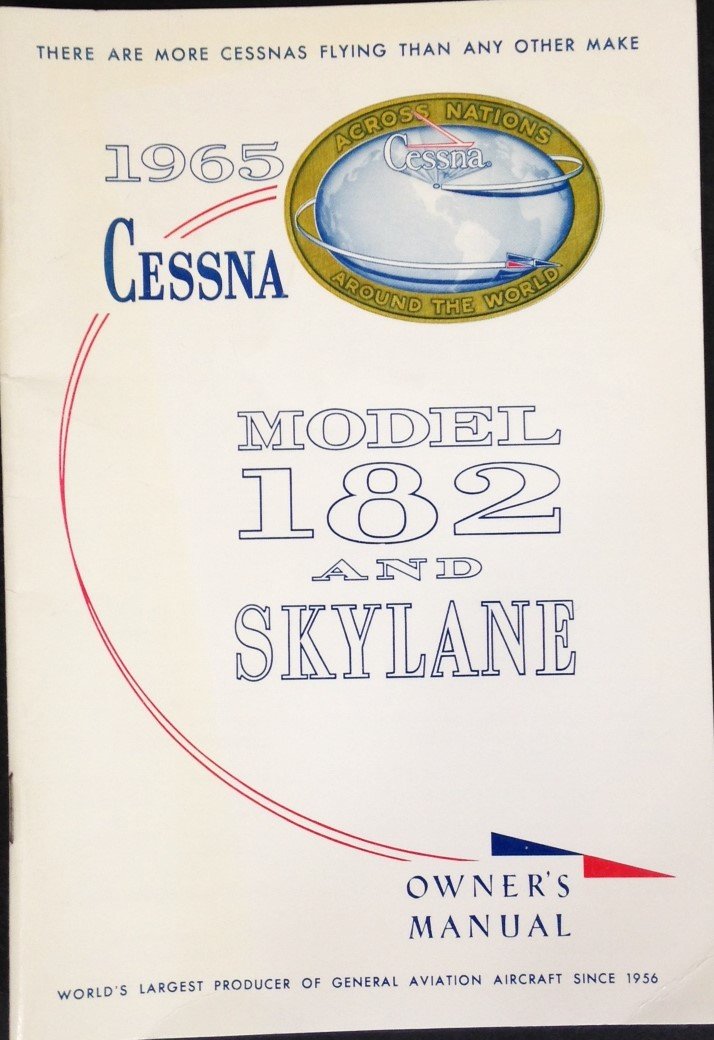
This image displays the front cover of the 1965 Cessna 182 and Skylane Owner's Manual. The cover features the year '1965', the 'Cessna' brand name, and the models '182 AND SKYLANE'. It also includes the Cessna logo with the text 'ACROSS NATIONS AROUND THE WORLD' and 'OWNER'S MANUAL'. Text at the top states 'THERE ARE MORE CESSNAS FLYING THAN ANY OTHER MAKE', and at the bottom, 'WORLD'S LARGEST PRODUCER OF GENERAL AVIATION AIRCRAFT SINCE 1956'.
General Information
The Cessna Model 182 and Skylane, introduced in 1965, are renowned single-engine, high-wing aircraft produced by Cessna, a world leader in general aviation aircraft manufacturing since 1956. These models are celebrated for their reliability, robust design, and suitability for various flight operations, from personal travel to utility purposes.
This manual specifically pertains to the 1965 models of the Cessna 182 and Skylane. Always verify the aircraft's serial number and model designation to ensure compatibility with the information provided in this document.
Setup and Pre-Flight Procedures
Proper pre-flight preparation is paramount for safe flight operations. This section outlines the essential steps to be performed before each flight.
Pre-Flight Inspection Checklist
- Exterior Inspection: Check wings, fuselage, tail, landing gear, tires, and control surfaces for any damage, fluid leaks, or obstructions.
- Engine Compartment: Verify oil level, fuel quantity, and inspect for loose connections or foreign objects.
- Propeller: Inspect for nicks, cracks, or bending.
- Fuel System: Drain fuel sumps to check for water or contaminants. Confirm fuel caps are secure.
- Lighting: Test all exterior and interior lights.
Cockpit Familiarization
Before engine start, ensure all controls are free and correct, instruments are functioning, and circuit breakers are in. Adjust seats and seatbelts for comfort and accessibility.
Weight and Balance
Calculate and verify the aircraft's weight and balance are within permissible limits for the planned flight. Refer to the detailed weight and balance section in the full manual for specific charts and calculations.
Operating Procedures
This section provides an overview of standard operating procedures for the Cessna 182 and Skylane. Detailed procedures, including emergency operations, are covered in the complete manual.
Engine Start-up
- Ensure propeller area is clear.
- Master switch ON.
- Fuel selector ON.
- Prime engine as required.
- Ignition switch START.
- Monitor oil pressure and engine indications.
Taxiing
Use rudder pedals for directional control and differential braking for tighter turns. Maintain a safe and controlled speed.
Take-off
Perform pre-takeoff checks. Apply full power smoothly, maintain directional control, and rotate at the specified airspeed. Establish a positive rate of climb.
Cruise Flight
Set appropriate power settings for desired altitude and speed. Monitor engine parameters and navigation instruments.
Landing
Execute a standard traffic pattern. Manage airspeed, flaps, and power for a stable approach. Touchdown smoothly on the main landing gear, followed by the nose wheel.
Engine Shut-down
After parking, follow the checklist for engine cool-down and shut-down. Secure the aircraft.
Maintenance and Inspection
Regular maintenance and inspections are vital for the airworthiness and safety of your aircraft. Adhere to the recommended inspection intervals and procedures.
Routine Checks
- Daily/Pre-flight: Visual inspection, fluid levels, tire pressure.
- 50-Hour Inspection: Intermediate checks of engine, airframe, and systems.
- 100-Hour/Annual Inspection: Comprehensive inspection performed by a certified aviation mechanic.
Fluid Levels
Regularly check engine oil, hydraulic fluid (if applicable), and brake fluid levels. Top up with approved fluids as necessary.
Cleaning and Care
Keep the aircraft clean to prevent corrosion and ensure proper functioning of moving parts. Use aviation-approved cleaning agents.
Note: All major maintenance, repairs, and inspections must be performed by appropriately certified aviation mechanics in accordance with regulatory requirements.
Troubleshooting
This section provides general guidance for common operational issues. For complex problems or issues affecting flight safety, always consult a certified aviation mechanic.
Engine Not Starting
- Check fuel quantity and selector position.
- Verify battery charge and master switch.
- Ensure proper priming procedure.
Warning Light Illumination
If a warning light illuminates during flight, refer immediately to the emergency procedures section of the full manual. On the ground, consult the maintenance schedule or a mechanic.
Unusual Noises or Vibrations
Any unusual sounds or vibrations should be investigated immediately. If in flight, land at the nearest suitable airport and have the aircraft inspected by a qualified mechanic.
Specifications
The 1965 Cessna Model 182 and Skylane aircraft are designed with specific performance and structural characteristics. For detailed technical specifications, including dimensions, weight limits, engine type, fuel capacity, performance charts (e.g., climb rate, cruising speed, range, service ceiling), and electrical system details, please refer to the comprehensive data tables and charts provided in the original owner's manual.
These specifications are critical for flight planning, weight and balance calculations, and understanding the operational envelope of the aircraft.
Safety Information
Operating an aircraft requires strict adherence to safety protocols and regulations. Your safety and the safety of others depend on your diligence.
- Always perform a thorough pre-flight inspection.
- Stay current with all applicable aviation regulations and airworthiness directives.
- Monitor weather conditions diligently and avoid adverse weather.
- Ensure all occupants are briefed on safety procedures and emergency exits.
- Never operate the aircraft under the influence of alcohol or drugs.
- Regularly review emergency procedures.