
KOLSOL F02
KOLSOL F02 Underground Wire Locator User Manual
Model: F02
1. Introduction
The KOLSOL F02 Underground Wire Locator is a professional tool designed to quickly and accurately locate buried wires, such as pet fence wires, metal wires, and electrical cables. It helps users identify the path of underground wires and pinpoint breaks, saving time and effort in troubleshooting and repair. This manual provides detailed instructions for the safe and effective use of your device.

Figure 1.1: KOLSOL F02 Underground Wire Locator (Transmitter and Receiver)
This image shows the main components of the Kolsol F02 Underground Wire Locator: the yellow transmitter unit on the left with red and black alligator clips, and the yellow receiver unit on the right with a black probe. Both units are connected by wires, illustrating their functional relationship.
2. Safety Information
Please read all safety warnings and instructions carefully before using this product. Failure to follow these instructions may result in electric shock, fire, or serious injury.
- Always ensure the wire being tested is de-energized before connecting the transmitter. This device is not designed for use on live circuits.
- Do not use the device in wet conditions or during lightning storms.
- Keep the device away from children.
- Use only the specified battery type (2 x AAA for receiver, 2 x 9V for transmitter). Ensure correct polarity when inserting batteries.
- If the device is damaged, do not attempt to repair it. Contact customer support.
3. Package Contents
Verify that all items are present in your package:
- 1 x KOLSOL F02 Transmitter
- 1 x KOLSOL F02 Receiver
- 1 x Earphones
- 1 x User Manual
- 2 x 9V Batteries (for Transmitter)
- 2 x AAA Batteries (for Receiver)
- 1 x Carrying Pouch

Figure 3.1: Complete Package Contents
This image displays the full contents of the Kolsol F02 package, including the transmitter, receiver, earphones, user manual, batteries, and a black carrying pouch, all neatly arranged with the product box in the background.
4. Product Overview
4.1. Transmitter Unit
The transmitter unit generates the signal that is sent through the wire to be traced.
- Power Switch: Turns the transmitter ON/OFF.
- Cable Scan/Battery Test Switch: Selects between cable scanning mode and battery test mode.
- Status Indicator: LED light indicating operational status.
- RJ11/RJ45 Ports: For connecting standard network or telephone cables.
- Alligator Clips: For direct connection to wires or ground stakes.
4.2. Receiver Unit
The receiver unit detects the signal emitted by the transmitter, allowing you to trace the wire's path and locate breaks.
- Power Indicator: LED light indicating power status.
- Push To Lamp Button: Activates the built-in LED flashlight.
- Sensitivity Adjustment Knob: Controls the receiver's sensitivity to the signal.
- Probe: The detection tip used to scan for the signal.
- Earphone Jack: For connecting the included earphones for clearer signal detection in noisy environments.

Figure 4.1: Receiver Unit Features
This image highlights the key features of the Kolsol F02 receiver unit, including its ability to detect cable breaks, a white LED flashlight, sound level adjustment, and external earphone compatibility, all depicted around the yellow receiver device.
5. Setup
5.1. Battery Installation
- Transmitter: Open the battery compartment on the back of the transmitter. Insert two 9V batteries, observing the correct polarity. Close the compartment.
- Receiver: Open the battery compartment on the back of the receiver. Insert two AAA batteries, observing the correct polarity. Close the compartment.
5.2. Connecting the Transmitter to the Wire
Before connecting, ensure the wire is de-energized.
- Connect the red alligator clip of the transmitter to one end of the wire you wish to trace.
- Connect the black alligator clip to a suitable ground point. This can be a metal stake driven into the ground, a grounded pipe, or another known ground source.
- Alternatively, for pet fence wires or similar closed loops, connect both alligator clips to the two ends of the wire at the break point or where you suspect a break.
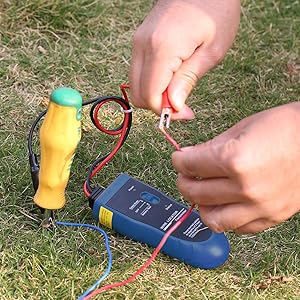
Figure 5.1: Connecting the Transmitter
This image shows a pair of hands connecting the red alligator clip of the Kolsol F02 transmitter to a wire, with the black clip connected to a ground stake, illustrating the proper setup for tracing an underground cable.
6. Operating Instructions
6.1. Tracing Wires
- Ensure the transmitter is connected to the wire and ground as described in Section 5.2.
- Turn on the transmitter by sliding the power switch to the ON position. The status indicator LED should light up.
- Turn on the receiver unit.
- Adjust the sensitivity knob on the receiver to a suitable level. Start with a lower sensitivity and increase if the signal is weak.
- Hold the receiver's probe close to the ground surface and move it along the suspected path of the wire.
- Listen for the audible signal from the receiver. The signal will be strongest directly over the wire.
- Follow the strongest signal to trace the wire's path.
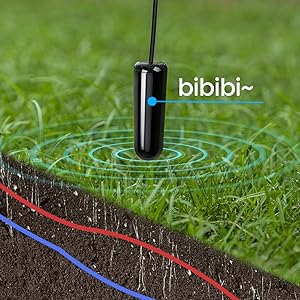
Figure 6.1: Tracing the Wire Signal
This image illustrates the Kolsol F02 receiver's probe being used to trace an underground wire, with concentric circles indicating the signal field and the text "bibibi~" representing the audible signal when the probe is directly over the wire.
6.2. Locating Wire Breaks
- Connect the transmitter to one end of the suspected broken wire and ground, or to both ends of a closed-loop wire (e.g., pet fence) at a known good point.
- Trace the wire as described in Section 6.1.
- As you approach the break point, the signal from the receiver will significantly weaken or disappear entirely.
- Pinpoint the exact location where the signal stops or becomes very faint. This indicates the approximate location of the wire break.
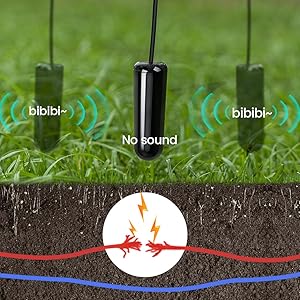
Figure 6.2: Locating a Wire Break
This image demonstrates how the Kolsol F02 receiver helps locate a wire break: the receiver emits a signal ("bibibi~") when over an intact wire, but produces "No sound" when it passes over a broken section, indicating the fault location.
6.3. Important Considerations for Wire Types
The KOLSOL F02 is optimized for specific wire configurations:
- Works best with single-strand wires.
- Can work with double-strand wires in parallel, but both wires must be broken to find the break point. It will not work properly if only one wire is broken.
- Not suitable for multi-strand wires (e.g., typical household electrical cables with multiple insulated conductors within one sheath).

Figure 6.3: Wire Type Compatibility
This diagram illustrates the Kolsol F02's compatibility with different wire types: it works with single-strand wires (labeled 1), but not with multi-strand wires. For double-strand wires, both must be broken for detection.
6.4. Applications
The KOLSOL F02 can be used in various scenarios:
- Locating pet fence wires.
- Tracing underground sprinkler system wires.
- Finding buried electrical wires (de-energized).
- Identifying which receptacles are on specific circuits.
- Pinpointing drilling sites before excavation to avoid buried lines.

Figure 6.4: Common Applications
This image collage showcases various applications for the Kolsol F02 wire locator, including finding wires for outdoor lighting, sprinkler systems, water features, and pet containment fences, demonstrating its versatility in outdoor settings.
7. Maintenance
- Cleaning: Wipe the device with a soft, damp cloth. Do not use abrasive cleaners or solvents.
- Battery Replacement: Replace batteries when the battery test indicator shows low power or when the device's performance degrades. Always remove batteries if the device will not be used for an extended period.
- Storage: Store the device in its carrying pouch in a cool, dry place, away from direct sunlight and extreme temperatures.
8. Troubleshooting
| Problem | Possible Cause | Solution |
|---|---|---|
| No signal from receiver | Transmitter not powered on; Low batteries; Incorrect connection; Wire break; Signal too weak. | Ensure transmitter is ON. Replace batteries. Check all connections. Adjust receiver sensitivity. |
| Weak or inconsistent signal | Low batteries; High soil moisture/density; Deeply buried wire; Interference. | Replace batteries. Increase receiver sensitivity. Ensure proper grounding. Minimize nearby electronic interference. |
| Cannot pinpoint break | Wire type not compatible (multi-strand); Not a complete break. | Confirm wire is single-strand or parallel double-strand with a complete break. |
9. Specifications
| Feature | Specification |
|---|---|
| Model Number | F02 |
| Brand | KOLSOL |
| Wire Tracing Depth | Up to 0.6 - 0.9 meters (2-3 feet) |
| Wire Tracing Length | Up to 304.8 meters (1000 feet) |
| Transmitter Power Source | 2 x 9V Batteries (included) |
| Receiver Power Source | 2 x AAA Batteries (included) |
| Operating Voltage (Min) | 9V |
| Max Operating Temperature | 28 Degrees Celsius |
| Item Weight | 431 Grams |
| Color | Yellow |
| ASIN | B01GDZLZOU |
| UPC | 889327006175, 889327044825 |

Figure 9.1: Range of Parameters
This image visually represents the operational range of the Kolsol F02 wire tracer, indicating its ability to detect wires up to 2-3 feet deep and over a length of 1000 feet, with diagrams showing the depth and length measurements.
10. Warranty and Support
For warranty information and technical support, please refer to the contact details provided with your purchase or visit the official KOLSOL website. Keep your purchase receipt as proof of purchase for warranty claims.
Ask a question about this manual
Ask about setup, troubleshooting, compatibility, parts, safety, or missing instructions. Manuals+ will review the question and use this page’s manual context to help answer it.