
1. Introduction
This manual provides detailed instructions for the installation, operation, and maintenance of your ASUS B150M-A Micro ATX Motherboard. The B150M-A supports 6th Generation Intel Processors and DDR4 memory, featuring advanced hardware safeguards with 5X Protection II, an intuitive UEFI BIOS, and Fan Xpert 2+ for optimized cooling. This motherboard is designed for reliable performance in various computing environments.
Key Features:
- 5X Protection II: Advanced hardware safeguards for comprehensive system protection.
- DDR4 Memory Compatibility: Supports high-speed DDR4 memory modules.
- UEFI BIOS with EZ Flash 3: User-friendly graphical BIOS interface with easy update functionality.
- Fan Xpert 2+: Advanced fan controls for optimal cooling and quiet operation.
- Gaming-Grade Audio: Enhanced audio experience with LED-illuminated shielding.
2. Safety Information
Always observe the following safety precautions when handling and installing the motherboard:
- Static Electricity: Wear an anti-static wrist strap or frequently touch a grounded object to discharge static electricity before handling components.
- Power Off: Ensure the power supply is disconnected from the wall outlet before installing or removing any components.
- Component Handling: Hold components by their edges, avoiding contact with pins, circuits, or connectors.
- Ventilation: Ensure adequate ventilation within the computer case to prevent overheating.
- Professional Installation: If you are unsure about any installation steps, consult a qualified technician.
3. Package Contents
Verify that all items are present in your motherboard package. If any item is damaged or missing, contact your retailer.

Image: Contents of the ASUS B150M-A motherboard retail box. This includes the motherboard, a rear I/O panel shield, a user guide, a support DVD, and two SATA data cables.
- ASUS B150M-A Motherboard
- Rear I/O Panel Shield
- User Guide
- Support DVD (containing drivers and utilities)
- SATA 6Gb/s Data Cables (x2)
4. Setup and Installation
4.1 Motherboard Layout
Familiarize yourself with the various components and connectors on the motherboard before installation.

Image: Overview of the ASUS B150M-A motherboard. Key areas include the LGA1151 CPU socket, four DDR4 DIMM slots, PCIe x16 and x1 slots, SATA ports, and various headers.

Image: Angled perspective of the ASUS B150M-A motherboard, providing a clearer view of the heatsink over the B150 chipset and the layout of the expansion slots.
4.2 CPU Installation (LGA1151)
- Locate the LGA1151 socket on the motherboard.
- Push the load lever down and away from the socket to open the retention frame.
- Carefully align the CPU with the socket, ensuring the gold triangle on the CPU matches the triangle on the socket. Do not force the CPU into the socket.
- Lower the CPU gently into the socket.
- Close the retention frame and push the load lever back into place until it clicks.
- Install the CPU cooler according to its manufacturer's instructions.
4.3 Memory Installation (DDR4)
The B150M-A motherboard has four DDR4 DIMM slots. For optimal performance, install memory modules in pairs.
- Open the clips at both ends of the DIMM slot.
- Align the memory module with the slot, ensuring the notch on the module matches the key in the slot.
- Press down firmly on both ends of the memory module until the clips snap into place.
- Verify that both clips are securely closed.
4.4 Expansion Card Installation
The motherboard features PCIe x16 and PCIe x1 slots for graphics cards and other expansion cards.
- Locate an available expansion slot.
- Remove the corresponding metal slot cover from your computer case.
- Align the expansion card with the slot and press down firmly until it is fully seated.
- Secure the card with a screw or the case's retention mechanism.
4.5 Storage Device Installation (SATA)
Connect your SATA hard drives or SSDs to the SATA 6Gb/s ports on the motherboard.
- Connect one end of a SATA data cable to a SATA port on the motherboard.
- Connect the other end of the SATA data cable to your storage device.
- Connect a SATA power cable from your power supply to the storage device.
4.6 Front Panel Connectors
Connect the cables from your computer case's front panel (power button, reset button, USB ports, audio jacks, etc.) to the corresponding headers on the motherboard. Refer to the motherboard layout diagram for header locations.
4.7 Power Connections
Ensure all necessary power cables from your power supply are connected to the motherboard and components.
- 24-pin ATX Power Connector: Connect the main 24-pin power cable from the PSU to the motherboard.
- 8-pin (or 4-pin) ATX 12V Power Connector: Connect the CPU power cable to the corresponding header near the CPU socket.
5. Operating Instructions
5.1 First Boot and BIOS Setup
After assembling your system, connect a monitor, keyboard, and mouse. Power on the system.
- Press the DEL key during startup to enter the UEFI BIOS Utility.
- The UEFI BIOS provides a graphical interface for configuring system settings, boot order, and hardware monitoring.
- Use the EZ Mode for basic settings or switch to Advanced Mode for more detailed configurations.
5.2 Driver Installation
After installing your operating system, install the necessary drivers for the motherboard components. These can be found on the included Support DVD or downloaded from the official ASUS website.
- Install chipset drivers.
- Install LAN drivers for network connectivity.
- Install audio drivers for sound functionality.
- Install any other relevant utility drivers.
5.3 Fan Control with Fan Xpert 2+
The Fan Xpert 2+ utility allows for advanced control over system fans, optimizing cooling performance and reducing noise levels. This utility can be accessed through the ASUS AI Suite software or directly within the UEFI BIOS.
6. Maintenance
6.1 Cleaning
Regularly clean your computer's interior to prevent dust buildup, which can lead to overheating and component failure. Use compressed air to remove dust from fans, heatsinks, and other components. Ensure the system is powered off and unplugged before cleaning.
6.2 BIOS Updates
Periodically check the ASUS support website for updated BIOS versions. BIOS updates can improve system stability, add support for new hardware, or fix bugs. Use the EZ Flash 3 utility within the BIOS to safely update the firmware, typically via a USB flash drive.
7. Troubleshooting
If you encounter issues with your motherboard, consider the following common troubleshooting steps:
- No Power/No POST:
- Verify all power cables (24-pin ATX, 8-pin CPU) are securely connected.
- Ensure the CPU and RAM are correctly seated.
- Try booting with only one RAM stick installed, testing each slot and module.
- Clear the CMOS (Complementary Metal-Oxide-Semiconductor) by removing the CMOS battery for a few minutes or using the clear CMOS jumper.
- Display Issues:
- Ensure the monitor cable is connected to the correct port (integrated graphics or discrete graphics card).
- Reseat the graphics card if applicable.
- Test with a different monitor or cable.
- Operating System Not Booting:
- Check boot order in BIOS.
- Verify storage device connections.
- Run a diagnostic tool on your storage drive.
- Peripheral Issues (USB, Audio, LAN):
- Ensure drivers are correctly installed.
- Check physical connections.
- Test with different peripherals.
For more advanced troubleshooting or persistent issues, refer to the comprehensive user manual on the ASUS support website or contact ASUS technical support.
8. Specifications
| Feature | Detail |
|---|---|
| Model Name | B150M-A |
| CPU Socket | LGA 1151 |
| Compatible Processors | Intel Core i5-6600K, Intel Core i7-6700K, Intel Core i5-7600K, Intel Core i7-7700K (and other 6th/7th Gen Intel Core processors with BIOS update) |
| Chipset | Intel B150 |
| RAM Memory Technology | DDR4 |
| Memory Slots | 4 x DIMM |
| Max Memory Size | 64 GB |
| Memory Clock Speed | 2133 MHz |
| Graphics Card Interface | Integrated (requires CPU with integrated graphics) |
| Total PCIe Ports | 1 x PCIe 3.0/2.0 x16, 2 x PCIe 3.0/2.0 x1 |
| Total SATA Ports | 6 x SATA 6Gb/s |
| USB Ports | Total 5 (USB 3.0, USB 2.0) + Internal Headers |
| Video Output | HDMI, DVI-D, VGA (D-Sub) |
| Audio | Realtek ALC887 8-Channel High Definition Audio CODEC |
| LAN | Realtek RTL8111H Gigabit LAN Controller |
| Form Factor | Micro ATX (9.2 inch x 7.3 inch) |
| Item Weight | 1.9 Pounds |
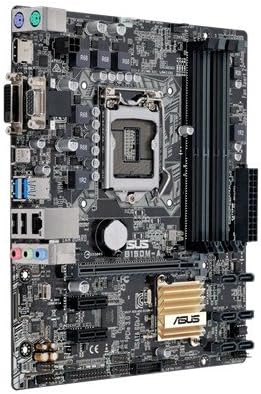
Image: The rear input/output panel of the ASUS B150M-A motherboard, featuring legacy PS/2 ports, VGA, DVI-D, HDMI for video output, USB 3.0 and USB 2.0 ports, a Gigabit Ethernet port, and 3.5mm audio jacks.
9. Warranty Information
ASUS products are manufactured to the highest quality standards. This motherboard is covered by a limited warranty provided by ASUS. The specific terms and duration of the warranty may vary by region and retailer. Please retain your proof of purchase for warranty claims.
For detailed warranty information, please visit the official ASUS support website or consult the warranty card included with your product.
10. Technical Support
If you require further assistance or encounter issues not covered in this manual, please contact ASUS technical support. You can find support resources, FAQs, driver downloads, and contact information on the official ASUS website:
When contacting support, please have your motherboard model (B150M-A) and serial number ready.