
1. Introduction
The M-D Building Products 19100 Gray Foam Backer Rod is designed for insertion into gaps and joints prior to applying caulk or sealant. Its primary function is to control the depth of the sealant, create a uniform joint size, and prevent three-point adhesion, which can lead to premature sealant failure. This product also helps reduce the amount of sealant required, making it a cost-effective solution for various sealing applications.
This backer rod is made from closed-cell foam, which resists moisture and is suitable for both indoor and outdoor use. It is ideal for concrete gaps, expansion joints, window and door frames, and other crack filling projects.

A close-up view of the M-D Building Products Gray Foam Backer Rod, illustrating its texture and cylindrical shape.
2. Product Features
- Quality Construction: Made from high-quality, weather-resistant closed-cell foam for durability and performance.
- Caulk Saver: Reduces the amount of caulk or sealant needed by filling a portion of the gap.
- Optimal Adhesion: Provides a firm, non-adhering surface for caulk, ensuring proper two-point adhesion and flexibility.
- Versatile Application: Suitable for concrete gaps, expansion joints, window sills, door frames, and general crack filling.
- Draft and Moisture Prevention: Helps to seal gaps, preventing drafts, dust, and moisture from entering.

This image highlights the closed-cell foam construction of the backer rod, indicating its 1-inch (2.5 cm) diameter and 10-foot (3 m) length. The closed-cell structure prevents moisture absorption.
3. Safety Information
While using this product, ensure proper ventilation in the work area. Keep out of reach of children. This product is not intended for use as a toy or flotation device. Always wear appropriate personal protective equipment, such as gloves, when handling sealants and tools.
4. Installation Instructions
Follow these steps for effective installation of the M-D Building Products Gray Foam Backer Rod:
- Prepare the Joint: Ensure the joint or gap is clean, dry, and free of loose debris, dust, and old sealant.
- Measure the Gap: Determine the width and depth of the gap. Select a backer rod with a diameter approximately 25% larger than the joint width to ensure a snug fit.
- Cut to Size: Cut the backer rod to the required length using scissors or a utility knife. For larger gaps, the rod can be twisted or doubled up to achieve the desired fill.
- Insert the Backer Rod: Firmly push the backer rod into the joint opening using a blunt tool or your fingers. Ensure it is compressed and fits snugly, without stretching. The rod should be recessed to the desired depth, typically allowing for a caulk bead that is half as deep as it is wide, but no less than 1/4 inch (6mm) deep.
- Apply Caulk: Once the backer rod is in place, apply the appropriate caulk or sealant over it, ensuring good adhesion to the sides of the joint.

A visual guide showing the three main steps for installing the backer rod: 1. Measuring the gap, 2. Cutting the rod to the appropriate length with scissors, and 3. Pressing the rod firmly into the gap.

Examples of the backer rod in use: one showing it inserted into a gap between concrete and a brick wall before caulking, and another showing caulk being applied over the installed backer rod. It is suitable for both indoor and outdoor applications.
5. Application Tips
- For optimal performance, ensure the backer rod is installed at a depth that allows for the recommended caulk thickness, typically 1/2 the width of the joint.
- Avoid puncturing or damaging the backer rod during installation, as this can compromise its closed-cell structure and moisture resistance.
- When sealing expansion joints in driveways or sidewalks, the backer rod provides a flexible base that accommodates movement.
- For irregular gaps, the flexibility of the foam allows it to conform to various shapes.
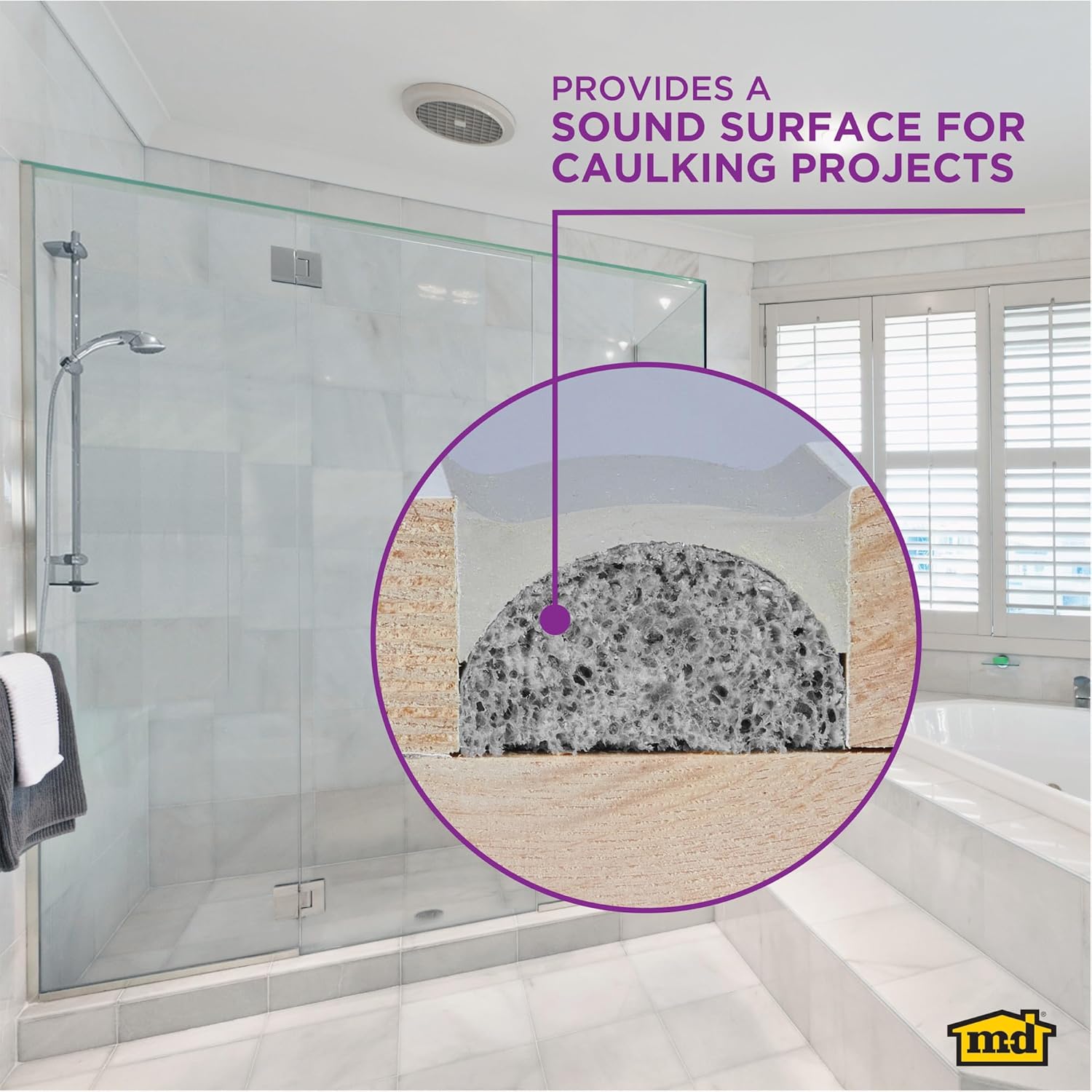
A diagram illustrating how the backer rod sits within a gap, providing a stable, non-adhering surface for caulk. This ensures proper caulk bead formation and prevents three-point adhesion, which can lead to premature caulk failure.

The backer rod installed around a window frame, demonstrating its ability to fill gaps and openings, thereby preventing drafts and the ingress of dirt and debris.
6. Maintenance
The M-D Building Products Gray Foam Backer Rod itself requires no maintenance once installed. However, regular inspection of the caulk or sealant applied over it is recommended. If the caulk shows signs of cracking, peeling, or deterioration, it should be removed and reapplied to maintain the integrity of the seal.
7. Troubleshooting
- Backer Rod Does Not Fit Snugly: If the backer rod is too small, it may not stay in place or provide adequate support for the caulk. Remove and replace with a larger diameter rod, or twist the existing rod to increase its effective diameter.
- Caulk Not Adhering Properly: Ensure the joint surfaces are clean and dry before installation. The backer rod should not be stretched during installation, as this can cause it to pull away from the joint sides.
- Backer Rod Punctured: If the backer rod is punctured, its closed-cell structure may be compromised, potentially allowing moisture to accumulate. Replace any damaged sections.
8. Specifications
| Attribute | Detail |
|---|---|
| Brand | M-D Building Products |
| Model Number | 19100 |
| Material | Closed-Cell Foam |
| Color | Gray |
| Length | 10 feet (120 inches) |
| Diameter | 1 inch |
9. Storage
Store the M-D Building Products Gray Foam Backer Rod in a cool, dry place away from direct sunlight and extreme temperatures. Keep it in its original packaging or a protective container to prevent damage or deformation.
10. Warranty
For information regarding the warranty of this product, please refer to the official M-D Building Products website or contact their customer service directly. Warranty terms and conditions may vary.
11. Customer Support
If you have any questions, require assistance with installation, or need further information about the M-D Building Products 19100 Gray Foam Backer Rod, please visit the official M-D Building Products website or contact their customer support department. Contact details can typically be found on the product packaging or the manufacturer's website.