
1. Introduction
This manual provides comprehensive instructions for the installation, operation, and maintenance of the Morningstar Tristar 30A MPPT Solar Charge Controller (TS-MPPT-30). This device is designed to optimize energy harvest from solar panels and manage battery charging for 12V, 24V, 36V, and 48V lead-acid and lithium-ion battery systems. Adherence to these instructions is crucial for safe and efficient operation and to ensure the longevity of the product.
2. Product Overview
The Morningstar TriStar 30A MPPT Solar Charge Controller is a robust and efficient solution for managing solar energy systems. It features Maximum Power Point Tracking (MPPT) technology to maximize energy output from solar arrays. The controller is designed for durability and includes advanced electronic protections.
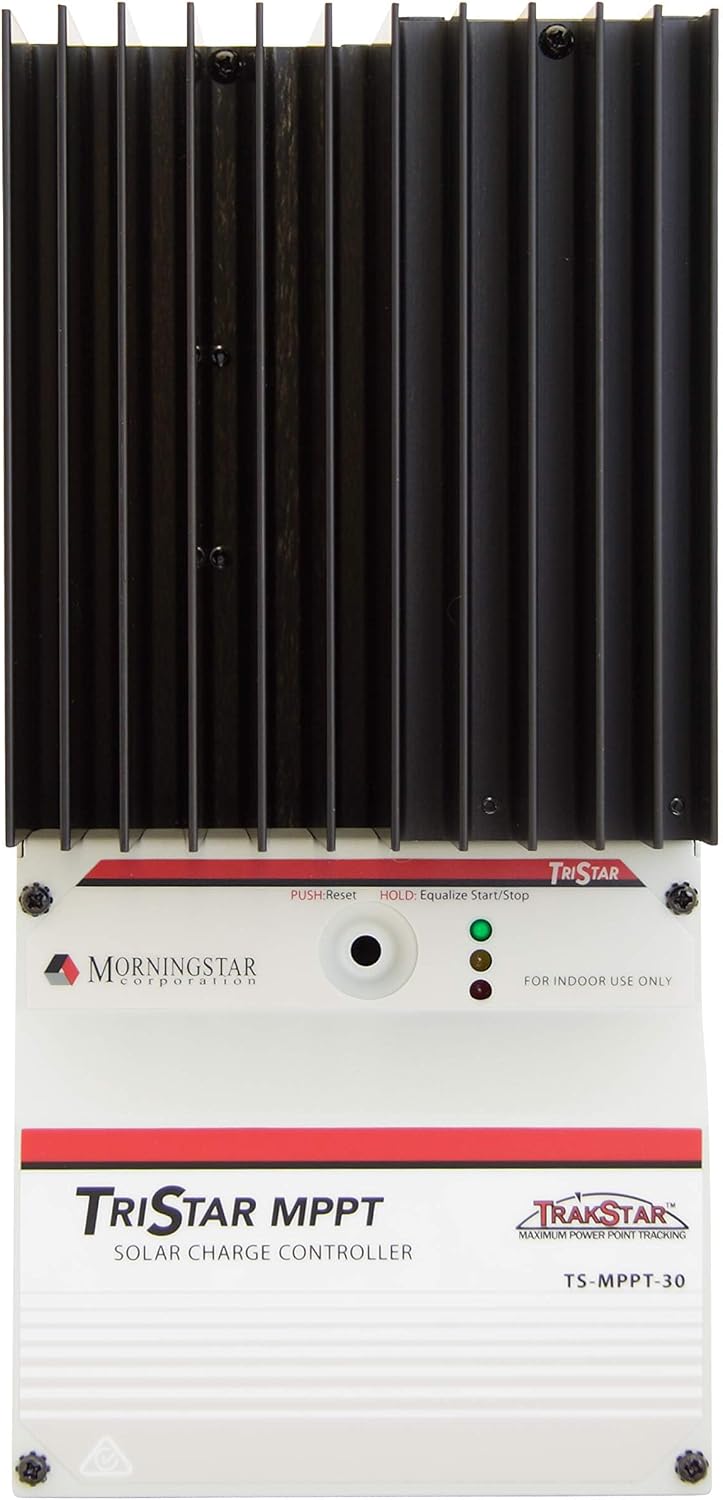
Figure 2.1: Front view of the Morningstar TriStar 30A MPPT Solar Charge Controller. This image displays the main unit with its prominent heat sink fins at the top, the Morningstar Corporation logo, TriStar branding, and LED indicators for operational status. The lower section shows the TriStar MPPT Solar Charge Controller label and the model number TS-MPPT-30.

Figure 2.2: Diagram highlighting key features and benefits of the TriStar MPPT controller. This visual emphasizes high reliability, more power output, communications capability, full adjustability, extensive electronic protections, simple mechanical interface, better battery charging, detailed information display, easy reset function, and low telecom noise. It illustrates the internal components and external features with numbered callouts.
Video 2.1: An official product video titled "TriStar Charge Controller" from the seller. This video provides a detailed visual overview of the TriStar Charge Controller, demonstrating its features, internal components, and design principles. It highlights the robust construction, heat management, and electronic protections, offering a comprehensive understanding of the product's capabilities and reliability.
3. Key Features and Benefits
- 30A MPPT Controller: Optimizes energy output from solar panels and accelerates charging times for 12/24/36/48V LA/Li batteries. Compatible with various solar modules and array configurations.
- Networking & Communications: Supports system monitoring, data logging, and adjustability via open standard MODBUS protocol and MS View software. Includes Ethernet for web-enabled local network interface, email, and text alerts, and Simple Network Management Protocols (SNMP).
- High Efficiency: Achieves peak efficiency of 99% with proprietary tracking algorithms. Features low self-consumption and continuous operation at full power up to 45°C without derating. Fanless passive heat sink design enhances reliability.
- Electronic Protections: Built-in protection against surges, short-circuits, overloads, and reverse polarity. Includes high voltage and high temperature disconnects. Advanced self-diagnostics provide alerts, and automatic recovery ensures continuous protection.
- Remote Temperature Sensor: Included to provide accurate battery temperature information, crucial when battery and controller temperatures differ significantly.
- Trusted Reliability: Designed in the USA by Morningstar Corporation, a global leader since 1993, known for the industry's lowest hardware failure rate.
4. Technology Overview: MPPT vs. PWM
Morningstar offers both MPPT (Maximum Power Point Tracking) and PWM (Pulse-Width Modulation) charge controllers. Understanding the differences helps in selecting the appropriate technology for your solar system.

Figure 4.1: A comparative chart illustrating the differences between MPPT and PWM charge controller technologies. MPPT is ideal for larger solar arrays, inconsistent weather, and offers maximum conversion efficiency. PWM is suitable for smaller arrays, consistent sunlight, and is more cost-effective where maximum energy extraction is less critical.
4.1. MPPT Technology (Maximum Power Point Tracking)
- Converts all available solar energy into electricity.
- Best for larger solar arrays (over 1kW) and/or places with seasonal, weather, or shading conditions that cause wide variations in solar "harvesting".
- Maximum conversion efficiency; additional circuitry makes them more complex and expensive.
- Morningstar TrackStar™ MPPT technology is an industry reference standard.
4.2. PWM Technology (Pulse-Width Modulation)
- Best for smaller solar arrays (under 1kW) and/or places with strong, consistent sunlight, minimal shading, and no physical space limitations.
- Simpler circuitry, more cost-effective in systems where extracting every last watt of solar electricity is less important.
- Morningstar's PWM controllers are built to the same quality and performance standard as their MPPT models.
5. Specifications
| Attribute | Value |
|---|---|
| Model Number | TS-MPPT-30 |
| Display Type | LED |
| Operating Temperature | Up to 45 Degrees Celsius |
| UPC | 743724208481 |
| Product Dimensions | 11.4 x 5.1 x 5.6 inches |
| Item Weight | 1 pounds (16 ounces) |
| Voltage | 12 Volts (DC) |
| Material | Steel |
| Color | White/Black |
| Included Components | Controller |
| Batteries Required | No |

Figure 5.1: A table comparing different TriStar MPPT models (TS-MPPT-30, TS-MPPT-45, TS-MPPT-60, TS-MPPT-60M). It details charge ratings, maximum PV open circuit voltage (Voc), nominal battery voltage, nominal max. operating power for different battery voltages, and peak efficiency. This provides a quick reference for the controller's capabilities across the product line.
6. Setup and Installation
Proper installation is critical for the safe and efficient operation of your TriStar MPPT controller. Refer to the detailed wiring diagrams and safety guidelines provided in the full product manual for specific instructions. Key considerations include:
- Mounting: Ensure the controller is mounted in a location that allows for adequate air circulation around the heat sink. The fanless design relies on passive cooling.
- Wiring: Connect solar panels, batteries, and loads according to the specified polarity and wire gauges. The large diameter, high torque, corrosion-resistant terminals ensure secure connections.
- Remote Temperature Sensor: Connect the included Remote Temperature Sensor to the battery to provide accurate temperature compensation for optimal charging.
- Networking: For advanced monitoring and control, connect the controller to a PC or network using the open standard MODBUS protocol or with the optional EMC-1 adapter for Ethernet connectivity.
7. Operating Instructions
The TriStar MPPT controller is designed for automated operation, but understanding its indicators and communication features is beneficial.
- LED Indicators: The controller features LED indicators that provide real-time status updates on battery charge, charging stage, and fault conditions. Refer to the full manual for a detailed explanation of LED patterns.
- Self-Diagnostics: The controller continuously monitors and analyzes system performance. In case of installation or operational errors, advanced self-diagnostics will alert the user. Automatic recovery features help maintain continuous protection.
- Backlit LCD Display (if applicable): Some TriStar models feature a backlit LCD display for direct viewing of system parameters and settings on-site.
- Reset Function: A push-button reset is available for manual reset and to start/stop battery equalization or load disconnect.
8. Maintenance
The Morningstar TriStar controller is designed for minimal maintenance due to its robust construction and fanless design. However, periodic checks are recommended to ensure optimal performance and longevity:
- Cleaning: Keep the heat sink fins clear of dust and debris to ensure efficient passive cooling.
- Connections: Periodically inspect all wiring connections to ensure they remain tight and free from corrosion.
- Environmental Conditions: Ensure the operating environment remains within the specified temperature range (up to 45°C) to prevent thermal stress on components.
9. Troubleshooting
The TriStar controller's self-diagnostics system is designed to identify and alert users to potential issues. In case of a fault, the LED indicators will provide specific patterns to help diagnose the problem. Common issues and initial troubleshooting steps include:
- No Charging: Check solar panel connections, battery voltage, and ensure no reverse polarity. Verify that the solar array is producing sufficient voltage.
- Overheating: Ensure the controller is mounted in a well-ventilated area and that the heat sink fins are not obstructed.
- Communication Issues: Verify cable connections for Modbus/Ethernet. Check software settings and network configuration.
- Battery Problems: The controller's self-diagnostics will alert to battery issues. Check battery connections, voltage, and overall health.
For detailed troubleshooting guides and fault codes, please refer to the comprehensive troubleshooting section in the full product manual or contact Morningstar technical support.
10. Warranty and Support
The Morningstar TriStar 30A MPPT Solar Charge Controller comes with a 5-year warranty, reflecting Morningstar Corporation's commitment to quality and reliability. This warranty period is significantly longer than many competitors in this class.
Morningstar Corporation, established in 1993, is a US company and a global leader in manufacturing PWM and MPPT solar charge controllers. They are renowned for the industry's lowest hardware failure rate and provide dependable, innovative technology for advanced solar applications.
For technical assistance, warranty claims, or any product-related inquiries, please contact Morningstar's U.S. based Tech Support. Their expertise ensures reliable support for mission-critical users worldwide.
11. Important Safety Information
Warning: This product may contain materials cautioned by California Proposition 65.
Always follow all local and national electrical codes during installation and operation. Ensure proper grounding and overcurrent protection. Disconnect all power sources before performing any maintenance or service on the controller.