
Introduction
This manual provides comprehensive information for the diagnosis, service procedures, adjustments, and specifications for the 2000 Toyota Celica. It is an essential resource for technicians and enthusiasts performing maintenance and repairs. The content is structured to guide users through various components and systems of the vehicle, ensuring accurate and efficient service.
This publication is officially reprinted under license from Toyota Motor Sales, U.S.A., Inc., ensuring its authenticity and adherence to factory standards.
Manual Organization and Content
The 2000 Toyota Celica Shop Service Repair Manual is typically divided into multiple volumes, covering various aspects of the vehicle. Each volume is organized into distinct sections to facilitate easy navigation and information retrieval.

Image 1: Front covers of the 2000 Toyota Celica Repair Manual, showing Volume 1 and Volume 2. Volume 1 covers Maintenance, Preparation, Specifications, and Diagnostics. Volume 2 covers Engine, Chassis, Body, and Electrical.
Volume 1 Sections (Example)

Image 2: A page from the manual showing the table of contents for Volume 1. Sections include Introduction, Maintenance, Preparation, Service Specifications, Diagnostics, Engine Mechanical, Emission Control, Cooling, Lubrication, Ignition, Starting, Charging, Clutch, Manual Transaxle (C56, C60), Automatic Transaxle (U240E, U341E), Suspension and Axle, Brake, Steering, Supplemental Restraint System, Body Electrical, Body, Air Conditioning, and an Alphabetical Index.
- Introduction (IN): General information and how to use the manual.
- Maintenance (MA): Scheduled maintenance procedures and intervals.
- Preparation (PP): Pre-service checks and preparations.
- Service Specifications (SS): Detailed specifications for various components.
- Diagnostics (DI): Troubleshooting procedures and diagnostic codes.
- Engine Mechanical (EM): Engine assembly, disassembly, and repair.
- Emission Control (EC): Systems related to vehicle emissions.
- Cooling (CO), Lubrication (LU), Ignition (IG), Starting (ST), Charging (CH): Specific system details.
- Clutch (CL), Manual Transaxle (MX), Automatic Transaxle (AX): Transmission and drivetrain components.
- Suspension and Axle (SA), Brake (BR), Steering (SR): Chassis components.
- Supplemental Restraint System (RS): Airbags and safety systems.
- Body Electrical (BE), Body (BO), Air Conditioning (AC): Electrical systems, bodywork, and climate control.
- Alphabetical Index (ID): For quick reference.
Volume 2 Sections (Example)

Image 3: A page from the manual showing the table of contents for Volume 2. This volume covers similar sections to Volume 1, indicating a comprehensive breakdown across both books. The note indicates that "screen toned sections" (likely referring to specific sub-sections or detailed diagrams) are found in Volume 2.
Volume 2 typically continues the detailed coverage of the systems introduced in Volume 1, often providing more in-depth information, wiring diagrams, and specific repair procedures for components like the engine, chassis, body, and electrical systems. The manual is approximately 1974 pages in total.
Using the Manual for Troubleshooting
The manual provides a structured approach to troubleshooting vehicle issues, starting from symptom identification to confirmation and repair. This systematic method helps in accurately diagnosing problems.
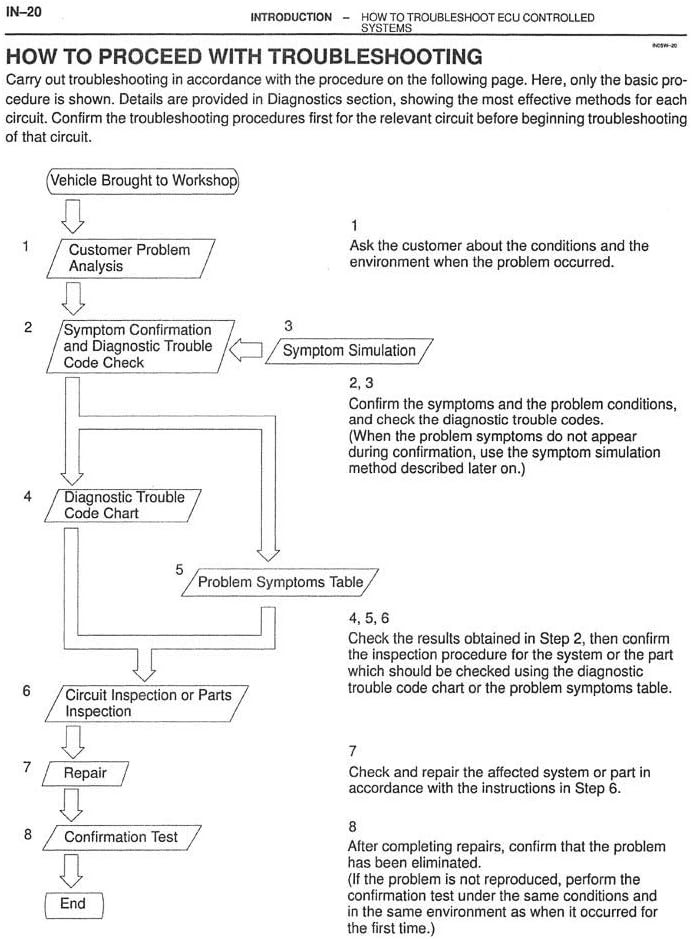
Image 4: A flowchart titled "HOW TO PROCEED WITH TROUBLESHOOTING" from the manual. It outlines an 8-step process: 1. Customer Problem Analysis, 2. Symptom Confirmation and Diagnostic Trouble Code Check, 3. Symptom Simulation, 4. Diagnostic Trouble Code Chart, 5. Problem Symptoms Table, 6. Circuit Inspection or Parts Inspection, 7. Repair, 8. Confirmation Test.
Troubleshooting Steps:
- Customer Problem Analysis: Interview the customer about the conditions and environment when the problem occurred.
- Symptom Confirmation and Diagnostic Trouble Code Check: Confirm symptoms and check diagnostic trouble codes.
- Symptom Simulation: If symptoms don't appear during confirmation, simulate the conditions.
- Diagnostic Trouble Code Chart: Refer to the diagnostic trouble code chart.
- Problem Symptoms Table: Consult the problem symptoms table.
- Circuit Inspection or Parts Inspection: Inspect relevant circuits or parts.
- Repair: Perform necessary repairs based on inspections.
- Confirmation Test: After repairs, confirm the problem is eliminated by repeating the conditions.
Maintenance and Repair Procedures
The manual details various maintenance and repair tasks, from routine checks to complex component overhauls. Each procedure is accompanied by diagrams and illustrations to guide the user.
Engine Diagnostics Example: Air Filter and Idle Speed

Image 5: A page from the Diagnostics section (DI-9) illustrating procedures for checking the air filter and idle speed. It includes an illustration of air filter inspection and detailed steps for checking engine idle speed, including target RPM ranges for 1ZZ-FE and 2ZZ-GE engines.
For example, the Diagnostics section provides clear instructions for checking the air filter, including visual inspection for dirt or oil, and cleaning/replacement procedures. It also outlines the steps for checking engine idle speed, specifying target RPMs for different engine types (1ZZ-FE: 650-750 rpm, 2ZZ-GE (M/T): 750-850 rpm, 2ZZ-GE (A/T): 700-800 rpm).
Engine Mechanical: Timing Chain Components

Image 6: A detailed diagram from the Engine Mechanical section (EM-15) showing the timing chain components and related parts for the Toyota Celica engine. It labels components such as the drive belt, PS pump, generator, engine mounting insulators, and the RH engine under cover, along with specified torque values.
The Engine Mechanical section includes detailed diagrams of components like the timing chain, illustrating their placement and connections. These diagrams are crucial for correct assembly and disassembly, often including specified torque values for fasteners.
Manual Transaxle Disassembly: Differential Case

Image 7: A page from the Manual Transaxle section (MX-49) detailing the disassembly of the differential case. It shows illustrations for removing the ring gear, vehicle speed sensor drive gear, and tapered roller bearing, along with instructions for inspecting side gear backlash and standard backlash specifications.
Complex procedures, such as manual transaxle disassembly, are broken down into sequential steps with accompanying illustrations. For instance, the differential case disassembly includes instructions for removing the ring gear, vehicle speed sensor drive gear, and tapered roller bearings, along with specifications for inspecting side gear backlash.
Specifications
The manual contains detailed specifications for various components, including torque values, clearances, and operational parameters. These specifications are crucial for ensuring proper assembly and function after repairs.
- Engine Types: 1ZZ-FE, 2ZZ-GE
- Idle Speed (1ZZ-FE): 650 – 750 rpm
- Idle Speed (2ZZ-GE M/T): 750 – 850 rpm
- Idle Speed (2ZZ-GE A/T): 700 – 800 rpm
- Side Gear Backlash (Differential Case): 0.05 – 0.20 mm (0.0020 – 0.0079 in.)
- Manual Transaxle Models: C56, C60
- Automatic Transaxle Models: U240E, U341E
- Approximate Page Count: 1974 pages
Warranty and Support
This product is a printed repair manual. Information regarding specific product warranties or technical support for the manual itself is typically provided by the publisher or vendor at the time of purchase. For vehicle-specific warranty information, please refer to your vehicle's original owner's manual or contact an authorized Toyota service center.