
1. Introduction
The KBMM-125 Adjustable Speed DC Drive is designed to precisely control the speed of 90 VDC Permanent Magnet (PM) and Shunt Wound DC motors. This versatile control unit can manage motors ranging from 1/100 HP to 3/4 HP, and up to 1.5 HP when an auxiliary heat sink is utilized. It offers a wide speed range of 50:1 with excellent load regulation of 1%.
Key features include an AC Line fuse, Armature Fuse holder, Auto Inhibit, Voltage Following, MOV transient protection, and trimpot adjustments for Minimum Speed (Min), Maximum Speed (Max), Acceleration (Accel), Deceleration (Decel), IR Compensation (IR), and Current Limit (CL). Please note that a Plug-in Horsepower Resistor is required for operation and must be purchased separately.
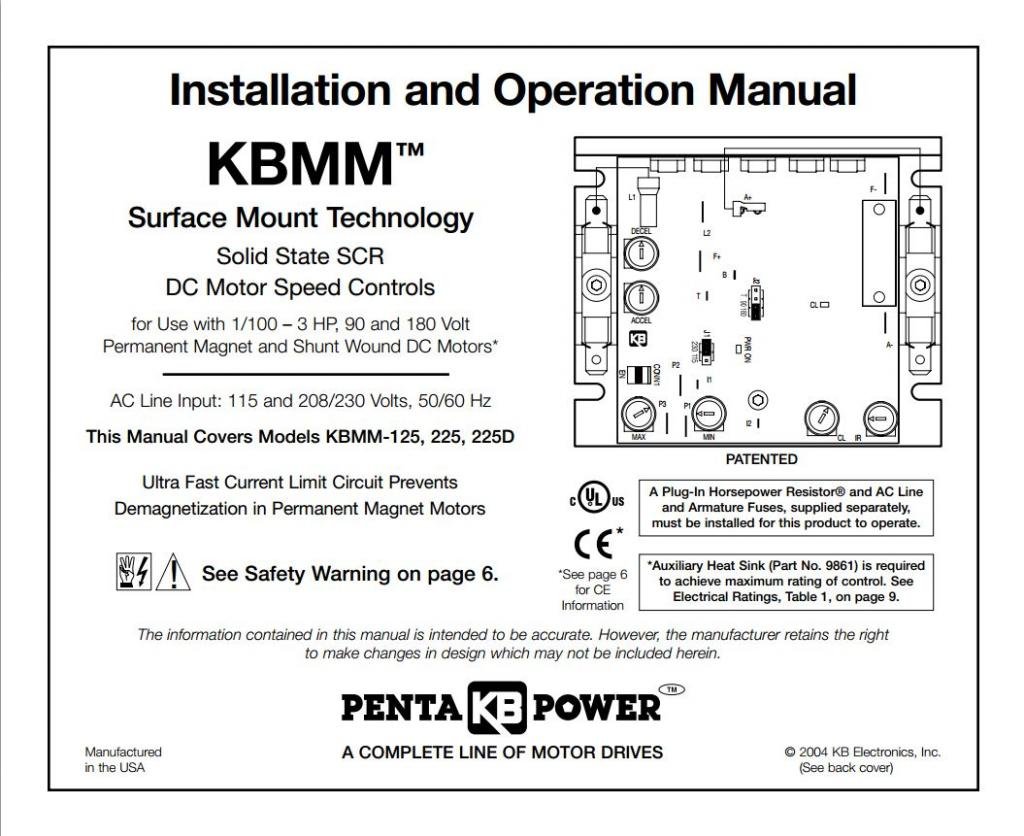
Figure 1: KBMM Installation and Operation Manual Cover, showing the product name and key features.
2. Important Safety Information
Read all instructions carefully before installing or operating the KBMM-125 DC Motor Control. Failure to follow these safety guidelines may result in electric shock, fire, or serious injury.
- Disconnect Power: Always disconnect all power to the control and motor before making any connections, adjustments, or performing maintenance.
- Qualified Personnel: Installation and servicing should only be performed by qualified electrical personnel.
- Proper Grounding: Ensure the control and motor are properly grounded according to local and national electrical codes.
- Horsepower Resistor: The drive will not operate without a plug-in horsepower resistor. Ensure the correct resistor is installed for your motor's horsepower rating.
- Fuses: AC Line and Armature Fuses are required and must be supplied separately. Install appropriate fuses as specified in the wiring diagram.
- Heat Sink: For applications requiring higher horsepower (e.g., 1.5 HP), an auxiliary heat sink (KB Part No. 9861) is recommended for optimal performance and heat dissipation.
- Environmental Conditions: Do not expose the control to moisture, excessive dust, corrosive gases, or extreme temperatures.
- MOV Transient Protection: The control includes MOV transient protection, but additional surge protection may be advisable in unstable power environments.
3. Product Overview
The KBMM-125 is a compact and robust DC motor speed control. Below are images illustrating the physical appearance and key components of the unit.

Figure 2: Angled view of the KBMM-125 control, highlighting the circuit board and red heat sink.

Figure 3: Top-down view of the KBMM-125 control board, showing trimpots for MIN, MAX, ACCEL, DECEL, IR, and CL.
The control board features clearly labeled connection points for AC input, motor armature, and various control signals. Adjustment trimpots are accessible for fine-tuning performance parameters.
4. Setup and Installation
4.1 Pre-Installation Requirements
- Plug-in Horsepower Resistor: A specific horsepower resistor is mandatory for operation and must be purchased separately. Ensure it matches your motor's horsepower.
- AC Line Fuse: An appropriate AC line fuse must be supplied and installed.
- Armature Fuse: An armature fuse is also required and must be supplied and installed.
- Auxiliary Heat Sink (Optional): For motors exceeding 3/4 HP (up to 1.5 HP), an auxiliary heat sink (KB Part No. 9861) is recommended for optimal performance and heat dissipation.
4.2 Mounting
The KBMM-125 can be mounted using the provided mounting holes. Refer to the mechanical specifications for precise dimensions and mounting hole locations.

Figure 4: Mechanical Specifications (inches/mm), detailing mounting points and overall dimensions.
- Mounting 'A' (6 slots) and Mounting 'B' (3 places, tapped 10-32) are available for securing the unit.
- Fuse holder and finger-safe cover mounting holes (2 places, tapped 6-32) are also indicated.
4.3 Wiring Connections
Refer to the control layout and general connection diagram for proper wiring. Ensure all connections are secure and comply with electrical codes.

Figure 5: Control Layout & General Connection Diagram (Model KBMM-225D Shown), applicable for KBMM-125 wiring.
- AC Line Input: Connect the 115 VAC (or 208/230 VAC if applicable) power supply to the L1 and L2 terminals. Ensure an AC Line Fuse is installed.
- Motor Armature: Connect the DC motor armature leads to the A+ and A- terminals. Install the Armature Fuse in its designated holder.
- Motor Field (Shunt Motors Only): For shunt wound motors, connect the motor field leads to the F+ and F- terminals.
- Main Speed Potentiometer: Connect the supplied 5K speed potentiometer to the P1, P2, and P3 terminals.
- Enable Switch (Optional): An external enable switch can be connected to the "Enable Switch" terminals (Close to Run, Open to Stop).
- Inhibit Switch (Optional): An external inhibit switch can be connected to the "Inhibit Switch" terminals (Open to Run, Close to Stop).
- DC Tach-Generator (Optional): If using a DC tach-generator for feedback, connect it to the appropriate terminals (Set J2 to "T" position).
Important: Ensure the correct Plug-in Horsepower Resistor is inserted into its receptacle before applying power.
5. Operating Instructions
5.1 Initial Power-Up
- Verify all wiring connections are correct and secure.
- Ensure the appropriate Plug-in Horsepower Resistor is installed.
- Turn the main speed potentiometer to its minimum position.
- Apply AC power to the control. The motor should remain stopped.
- Slowly rotate the speed potentiometer clockwise. The motor should begin to rotate and increase speed.
5.2 Adjustments (Trimpots)
The KBMM-125 features several trimpots for fine-tuning motor performance. Use a small, non-conductive screwdriver for adjustments.
- MIN (Minimum Speed): Adjusts the lowest motor speed when the speed potentiometer is at its minimum setting.
- MAX (Maximum Speed): Adjusts the highest motor speed when the speed potentiometer is at its maximum setting.
- ACCEL (Acceleration): Controls the rate at which the motor speeds up from a lower to a higher setpoint. Clockwise increases acceleration time.
- DECEL (Deceleration): Controls the rate at which the motor slows down from a higher to a lower setpoint. Clockwise increases deceleration time.
- IR (IR Compensation): Compensates for motor speed drop under load. Adjust clockwise to increase compensation. Over-compensation can lead to instability.
- CL (Current Limit): Sets the maximum armature current allowed. This protects the motor and control from overcurrent conditions. Adjust carefully to prevent motor stalling or damage.
Note: Make small adjustments and observe motor behavior. Refer to the connection diagram (Figure 5) for trimpot locations.
6. Maintenance
The KBMM-125 DC Motor Control is designed for reliable operation with minimal maintenance. However, periodic checks can help ensure longevity and optimal performance.
- Power Disconnection: Always disconnect power before performing any maintenance.
- Cleanliness: Keep the control unit clean and free from dust, dirt, and debris. Use a soft, dry brush or compressed air to remove accumulated dust.
- Connections: Periodically check all electrical connections for tightness. Loose connections can cause intermittent operation or overheating.
- Fuses: Inspect the AC Line and Armature Fuses for any signs of damage or blowing. Replace only with fuses of the specified rating.
- Ventilation: Ensure adequate airflow around the control, especially if an auxiliary heat sink is installed, to prevent overheating.
- Environmental Check: Verify that the operating environment remains within the specified temperature and humidity ranges.
7. Troubleshooting
This section provides solutions to common issues encountered with the KBMM-125 DC Motor Control. Always disconnect power before attempting any troubleshooting or repairs.
| Problem | Possible Cause | Solution |
|---|---|---|
| Motor does not run. | No AC input power. Blown AC Line Fuse. No Plug-in Horsepower Resistor. Blown Armature Fuse. Faulty motor or wiring. Enable switch open (if used). Inhibit switch closed (if used). | Check power supply. Replace AC Line Fuse. Install correct HP resistor. Replace Armature Fuse. Test motor and wiring. Close enable switch. Open inhibit switch. |
| Motor runs but speed is erratic or unstable. | Loose wiring connections. Incorrect IR Compensation (IR) setting. Motor brush issues. Faulty speed potentiometer. | Check and tighten all connections. Adjust IR trimpot carefully. Inspect motor brushes. Test or replace potentiometer. |
| Motor does not reach full speed. | MAX trimpot set too low. Incorrect HP resistor. Motor overloaded. | Adjust MAX trimpot clockwise. Verify correct HP resistor is installed. Reduce motor load. |
| Motor accelerates/decelerates too slowly/quickly. | ACCEL/DECEL trimpots incorrectly set. | Adjust ACCEL/DECEL trimpots as desired. |
| Control unit overheats. | Insufficient ventilation. Motor overloaded. Auxiliary heat sink not installed (for higher HP). | Ensure proper airflow. Reduce motor load. Install auxiliary heat sink if operating at higher HP. |
8. Specifications
Technical specifications for the KBMM-125 DC Motor Control.
| Feature | Detail |
|---|---|
| Model Number | KBMM-125 |
| AC Line Input | 115 VAC, 50/60 Hz (Also supports 208/230 VAC with appropriate configuration) |
| Motor Type | 90 VDC Permanent Magnet (PM) & Shunt Wound DC Motors |
| Horsepower Range | 1/100 HP - 3/4 HP (1.5 HP with auxiliary heat sink) |
| Speed Range | 50:1 |
| Load Regulation | 1% |
| Dimensions (Product) | 4.3 x 3.6 x 1.3 inches |
| Weight (Product) | 12.8 ounces |
| Certifications | UL, CSA, CE, C-tick (as per manual cover) |
| Protection | AC Line fuse, Armature Fuse holder, MOV transient protection, Direct-Fed current limit |
| Adjustments | Min, Max, Accel, Decel, IR, CL trimpots |
9. Warranty and Support
For warranty information, technical support, or to purchase replacement parts and accessories (such as Plug-in Horsepower Resistors or auxiliary heat sinks), please contact KB Electronics directly or refer to their official website. Keep your purchase receipt for warranty claims.
KB Electronics products are available worldwide from stocking distributors. For the nearest distributor, please visit the KB Electronics website or contact their customer service department.


