
Briggs & Stratton 49T877-0004-G1

Briggs & Stratton 49T877-0004-G1 Commercial Turf Series Engine
Instruction Manual
Model: 49T877-0004-G1
1. Introduction
This manual provides essential information for the safe and efficient installation, operation, and maintenance of your Briggs & Stratton 49T877-0004-G1 Commercial Turf Series V-Twin engine. Please read this manual thoroughly before operating the engine to ensure proper use and to prevent injury or damage.
The Briggs & Stratton 49T877-0004-G1 is a 27 Gross HP (810cc) V-Twin engine designed for commercial turf applications, featuring a cyclonic air filter for enhanced debris protection and extended service intervals.
2. Safety Information
WARNING: Failure to follow these safety instructions could result in serious injury or death.
- Always wear appropriate personal protective equipment (PPE) such as safety glasses, gloves, and hearing protection when working with the engine.
- Ensure the engine is turned off, cooled, and spark plug wires are disconnected before performing any maintenance or adjustments.
- Operate the engine in a well-ventilated area to avoid carbon monoxide poisoning.
- Fuel is highly flammable. Handle fuel with extreme care, away from open flames or sparks. Store fuel in approved containers.
- Keep hands, feet, and clothing away from moving parts.
- Refer to the equipment manufacturer's manual for additional safety precautions specific to the machine powered by this engine.

Image: Engine side view showing warning labels and fuel filter. Always observe all warning labels on the engine.
3. Setup and Installation
This section outlines the general steps for preparing your engine for use. For detailed installation instructions, always consult the equipment manufacturer's manual where this engine will be installed.
3.1 Unboxing and Inspection
Carefully remove the engine from its packaging. Inspect for any shipping damage. Report any damage immediately to the carrier and your dealer.
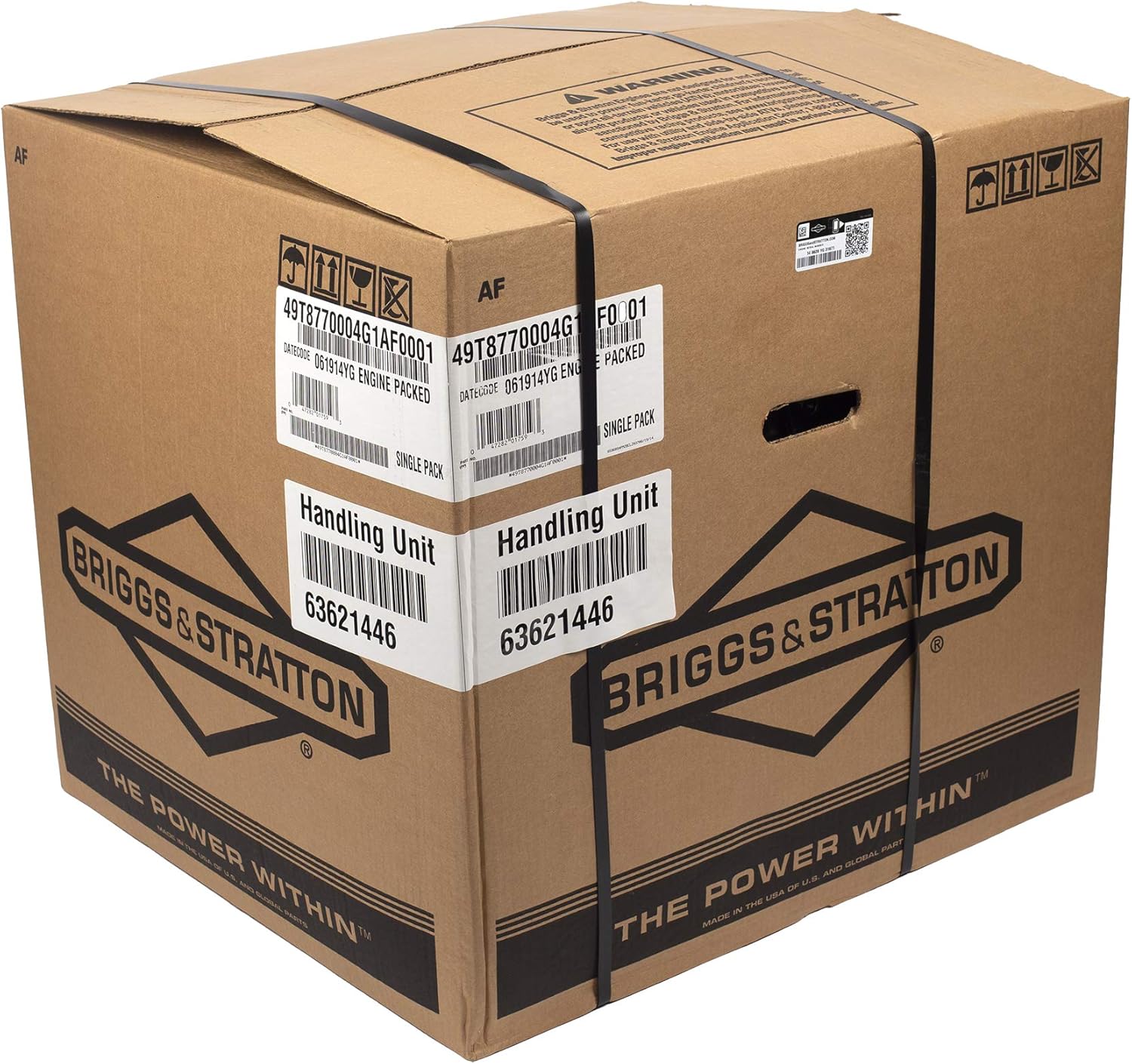
Image: Briggs & Stratton engine packaged in its shipping box. Ensure the packaging is intact upon arrival.
3.2 Mounting the Engine
Mount the engine securely to the equipment frame using appropriate hardware. Ensure proper alignment of the crankshaft with the driven component (e.g., PTO shaft). The mounting holes are designed for standard fitment, but verification with your equipment is crucial.

Image: Diagram illustrating general engine installation points. Consult your equipment's manual for specific mounting details.
3.3 Electrical Connections
Connect the engine's electrical harness to the equipment's wiring system. This typically includes connections for the starter, ignition kill switch, and charging system. Refer to the wiring diagram provided by the equipment manufacturer.

Image: Side view of the engine highlighting electrical connections and the oil fill tube. Ensure all connections are secure.
For more information, scan the QR code on the engine label or visit: http://m.briggsandstratton.com/qr/140620YG31871/
3.4 Fuel and Oil
Fill the engine with the recommended type and amount of engine oil. Refer to the "Specifications" section for oil type. Fill the fuel tank with fresh, clean gasoline. Do not overfill.
4. Operating Instructions
4.1 Pre-Start Checklist
- Check engine oil level.
- Ensure fuel tank is adequately filled.
- Inspect air filter for cleanliness.
- Verify all connections (electrical, fuel lines) are secure.
- Clear the area around the equipment of any obstructions.
4.2 Starting the Engine
- Ensure the equipment's PTO (Power Take-Off) is disengaged.
- Set the choke to the "FULL" position (if cold starting).
- Set the throttle to the "FAST" position.
- Turn the ignition key to the "START" position until the engine starts. Release the key once started.
- Gradually move the choke to the "OFF" position as the engine warms up.
4.3 Running the Engine
Allow the engine to warm up for a few minutes before engaging the PTO or applying heavy loads. Operate the engine at the recommended RPM for optimal performance and fuel efficiency, as specified by the equipment manufacturer.
4.4 Shutting Down the Engine
- Disengage the PTO and reduce the throttle to the "SLOW" or "IDLE" position.
- Allow the engine to cool down for a few minutes.
- Turn the ignition key to the "OFF" position.
5. Maintenance
Regular maintenance is crucial for the longevity and optimal performance of your Briggs & Stratton engine. Always refer to the maintenance schedule in your engine's full owner's manual for specific intervals.

Image: General diagram illustrating various maintenance points on an engine.
5.1 Air Filter Maintenance
This engine features a unique cyclonic air filter system designed for extended service intervals. Regularly inspect the air filter for dirt and debris. Clean or replace as necessary. Operating with a dirty air filter can reduce engine performance and life.

Image: Top view of the Briggs & Stratton engine, highlighting the cyclonic air filter housing.
5.2 Oil Changes
Check the engine oil level before each use. Change the engine oil and replace the spin-on oil filter at recommended intervals. Refer to the "Specifications" section for recommended oil type.

Image: Side view of the engine, showing the location of the spin-on oil filter and oil drain plug.
5.3 Spark Plugs
Inspect and clean spark plugs annually or every 100 hours of operation. Replace if electrodes are worn or pitted. Ensure proper gap setting.
5.4 Cooling System
Regularly inspect cooling fins for debris accumulation. The engine features cooling fin inspection panels to speed debris inspection and cleaning. Keep cooling fins clear to prevent overheating.
6. Troubleshooting
This section provides solutions to common engine problems. For more complex issues, contact a qualified service technician.
| Problem | Possible Cause | Solution |
|---|---|---|
| Engine will not start | No fuel, stale fuel, clogged fuel filter, faulty spark plug, dead battery, incorrect choke setting. | Check fuel level, replace stale fuel, replace fuel filter, inspect/replace spark plug, charge/replace battery, adjust choke. |
| Engine runs rough | Dirty air filter, fouled spark plug, stale fuel, carburetor issues. | Clean/replace air filter, clean/replace spark plug, use fresh fuel, consult service manual for carburetor adjustment. |
| Loss of power | Dirty air filter, low oil level, clogged fuel filter, engine overheating. | Clean/replace air filter, check/add oil, replace fuel filter, check cooling fins. |
| Engine overheats | Clogged cooling fins, low oil level, operating in high ambient temperatures. | Clean cooling fins, check/add oil, ensure adequate ventilation. |
7. Specifications
Key technical specifications for the Briggs & Stratton 49T877-0004-G1 engine:
- Model Number: 49T877-0004-G1
- Engine Type: Commercial Turf Series V-Twin
- Gross Horsepower: 27 HP (at 3600 RPM per SAE J1940)
- Displacement: 810 cc
- Cylinder Design: Twin cylinder with cast iron sleeves
- Air Cleaner: Cyclonic filter
- Charging System: Alternator, 16 amp with regulator
- Bearings: High radial load PTO
- Bore Size: 3.300 in.
- Stroke: 2.90 in.
- Lubrication: Full pressure with spin-on oil filter
- Starting System: 12V heavy duty starter
- Fuel Type: Unleaded gasoline (minimum 87 octane)
- Oil Type: Briggs & Stratton SAE 30W or 10W-30 (refer to owner's manual for temperature-specific recommendations)
- Item Weight: Approximately 0.01 Ounces (Note: This weight from source data is likely a placeholder and not the actual engine weight.)
- UPC: 047282017593
8. Warranty and Support
This Briggs & Stratton engine comes with a two-year limited consumer and commercial engine warranty. For detailed warranty terms and conditions, please refer to the official Briggs & Stratton warranty statement included with your engine or visit the official Briggs & Stratton website.
For technical support, parts, or service, please contact your authorized Briggs & Stratton dealer or visit the official Briggs & Stratton website:
Briggs & Stratton Official Store

Image: Graphic representing customer assistance and support resources.
Related Documents - 49T877-0004-G1
 |
Briggs & Stratton Engine Operator and Owner Manual for Model Series 110400, 111400, 113400, 120400, 121400, 123400 Comprehensive operator and owner's manual for Briggs & Stratton Intek and IntekPRO OHV engines (Model Series 110400, 111400, 113400, 120400, 121400, 123400). Includes safety instructions, maintenance schedules, oil and fuel recommendations, starting and stopping procedures, adjustments, service, storage, specifications, and warranty details. |
 |
Briggs & Stratton 2022 Power Guide: Engines for Europe, Middle East & Africa Explore the comprehensive 2022 Briggs & Stratton Power Guide for Europe, Middle East, and Africa. Discover a wide range of gasoline and lithium-ion engines, featuring innovative technologies like INSTART, ReadyStart, and Mow N' Stow, designed for various power equipment applications. |
 |
Briggs & Stratton 386400 Illustrated Parts List and Service Information Comprehensive illustrated parts list for the Briggs & Stratton 386400 engine series, including part numbers, descriptions, and diagrams. Essential for maintenance and repair. |
 |
Briggs & Stratton 42" Mower Deck Parts Manual - Model 1696796-00 Detailed parts manual for the Briggs & Stratton 42-inch Mower Deck (Mfg. No: 1696796-00). Find exploded diagrams, part numbers, and torque specifications for maintenance and repair of your lawn mower deck. |
 |
Briggs & Stratton Operator's Manual for Zero Turn Mower Comprehensive operator's manual for Briggs & Stratton zero-turn mowers, covering safety, operation, maintenance, and troubleshooting. Includes detailed instructions and diagrams. |
 |
Briggs & Stratton Corvette 300 18" Walk Behind Mower Parts Manual Comprehensive parts manual for the Briggs & Stratton Corvette 300 18" Walk Behind Mower (Mfg. No: 2692089-00). Includes detailed component breakdowns, part numbers, diagrams, and torque specifications for maintenance and repair. |
Ask a question about this manual
Ask about setup, troubleshooting, compatibility, parts, safety, or missing instructions. Manuals+ will review the question and use this page’s manual context to help answer it.