1. Introduction
This manual provides detailed instructions for the installation, setup, and operation of your GIGABYTE GA-B85M-DS3H motherboard. Designed for 4th Generation Intel Core processors, this motherboard features GIGABYTE Ultra Durable 4 Plus Technology, GIGABYTE Hybrid digital power engine, and GIGABYTE UEFI DualBIOS for reliable performance. Please read this manual thoroughly before beginning installation to ensure proper setup and to maximize the benefits of your new motherboard.
2. Safety Information
- Always disconnect the power cord from the wall outlet before touching any component.
- Wear an anti-static wrist strap when handling the motherboard or other components to prevent electrostatic discharge (ESD) damage.
- Handle components by their edges to avoid touching sensitive parts.
- Ensure proper ventilation within your PC case to prevent overheating.
- Keep the motherboard away from moisture and extreme temperatures.
- Refer to the CPU and memory manuals for specific installation instructions.
3. Package Contents
Verify that all items listed below are present in your motherboard package. If any item is missing or damaged, contact your retailer.
- GIGABYTE GA-B85M-DS3H Motherboard
- I/O Shield
- SATA Data Cables
- User Manual / Quick Installation Guide
- Driver CD/DVD

Figure 3.1: Motherboard and included accessories, typically including an I/O shield, SATA cables, and documentation.
4. Motherboard Layout
Familiarize yourself with the various components and connectors on your motherboard before installation.

Figure 4.1: Top-down view of the GIGABYTE GA-B85M-DS3H motherboard, showing the CPU socket, RAM slots, and various headers.

Figure 4.2: Angled view of the GIGABYTE GA-B85M-DS3H motherboard, highlighting the various ports and connectors from a different perspective.
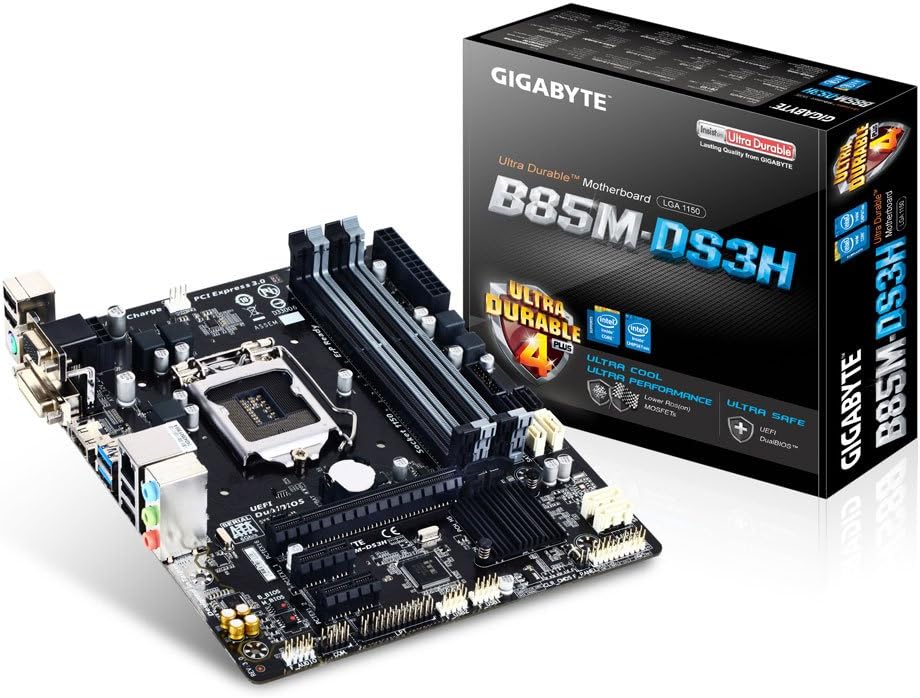
Figure 4.3: The GIGABYTE GA-B85M-DS3H motherboard displayed alongside its retail packaging, emphasizing its Ultra Durable 4 Plus features.

Figure 4.4: Close-up view of the rear I/O panel, showing ports for PS/2, D-SUB, DVI-D, HDMI, USB 3.0/2.0, LAN, and audio jacks.
Figure 4.5: Diagram illustrating key features such as High Quality Audio Capacitors, Audio Noise Guard, High ESD Protection, Long Lifespan All Solid Caps, Humidity Protection, High Temperature Protection, Power Failure Protection, and 3x Higher Surge Protection.
5. Setup & Installation
5.1. CPU Installation
- Locate the LGA 1150 CPU socket on the motherboard.
- Open the CPU socket lever and lift the metal load plate.
- Carefully align the CPU with the socket, ensuring the golden triangle on the CPU matches the triangle on the socket.
- Gently place the CPU into the socket without forcing it.
- Close the load plate and secure it with the lever.
- Apply thermal paste and install the CPU cooler according to its instructions.
5.2. Memory (RAM) Installation
The motherboard supports up to 32GB of DDR3 1600/1333 MHz memory across four DIMM slots.
- Open the clips at both ends of the DIMM slot.
- Align the notch on the DDR3 memory module with the key in the DIMM slot.
- Insert the memory module firmly into the slot until the clips snap into place.
- For dual-channel configuration, install memory modules in matching colored slots (e.g., DDR3_1 and DDR3_2).
5.3. Storage Device Connection (SATA)
Connect your SATA 6Gb/s (SATA3) and SATA 3Gb/s (SATA2) devices.
- The motherboard features 4x SATA 6Gb/s ports and 2x SATA 3Gb/s ports.
- Connect one end of the SATA data cable to the SATA port on the motherboard and the other end to your storage device (HDD/SSD).
- Connect the SATA power cable from your power supply to the storage device.
5.4. Expansion Card Installation
The motherboard includes 1x PCI Express 3.0 x16 slot and 2x PCI Express 2.0 x1 slots.
- Select an appropriate PCI Express slot for your expansion card (e.g., graphics card, network card).
- Remove the corresponding metal bracket cover from your PC case.
- Align the card with the slot and press down firmly until it is securely seated.
- Secure the card to the case with a screw.
5.5. Front Panel Connectors
Connect the cables from your PC case's front panel to the corresponding headers on the motherboard. Refer to the motherboard diagram (Figure 4.1) for header locations.
- F_PANEL: Power button, reset button, HDD LED, power LED.
- F_AUDIO: Front panel audio jacks.
- F_USB30: Front panel USB 3.0 ports.
- F_USB20: Front panel USB 2.0 ports.
5.6. Power Connections
Connect the main ATX power connector and the CPU power connector from your power supply to the motherboard.
- ATX (24-pin): Main power connector.
- ATX_12V (8-pin): CPU power connector.
6. Operation
6.1. BIOS/UEFI Setup
The GIGABYTE UEFI DualBIOS provides a user-friendly interface for configuring system settings. To enter BIOS setup, press the DEL key during system startup.
- Configure boot order for your operating system installation.
- Adjust system clock and date.
- Monitor system health (temperatures, fan speeds).
- Enable or disable integrated peripherals.
6.2. Driver Installation
After installing your operating system, install the necessary drivers for optimal performance. Drivers can be found on the included driver CD/DVD or downloaded from the official GIGABYTE website.
- Chipset Drivers
- LAN Drivers
- Audio Drivers
- Graphics Drivers (if using integrated graphics)
- USB 3.0 Drivers
7. Maintenance
7.1. Cleaning
Regularly clean your PC to prevent dust buildup, which can lead to overheating and reduced performance. Use compressed air to remove dust from components and ensure proper airflow.
7.2. BIOS Updates
Periodically check the GIGABYTE website for BIOS updates. BIOS updates can improve system stability, add support for new hardware, or fix bugs. Follow the instructions provided by GIGABYTE carefully when updating the BIOS.
8. Troubleshooting
- No Power: Ensure all power cables (24-pin ATX, 8-pin CPU) are securely connected. Check power supply functionality.
- No Display: Verify that the monitor is connected to the correct video output (onboard or discrete graphics card). Reseat the graphics card and RAM modules.
- System Instability/Crashes: Check RAM modules for proper seating. Ensure CPU cooler is correctly installed and making good contact. Update drivers and BIOS.
- Operating System Not Booting: Check boot order in BIOS. Verify storage device connections.
- Peripheral Not Detected: Ensure USB/SATA devices are properly connected. Install necessary drivers.
9. Specifications
| Feature | Detail |
|---|---|
| CPU Socket | LGA 1150 |
| Chipset | Intel B85 Express |
| Memory Slots | 4x DDR3 DIMM, Dual Channel |
| Max Memory Capacity | 32GB |
| Memory Speed | DDR3 1600/1333 MHz |
| PCIe Slots | 1x PCI Express 3.0 x16, 2x PCI Express 2.0 x1 |
| SATA Ports | 4x SATA 6Gb/s, 2x SATA 3Gb/s |
| USB Ports (Rear) | 2x USB 3.0/2.0, 4x USB 2.0/1.1 |
| USB Ports (Internal Headers) | 2x USB 3.0/2.0, 4x USB 2.0/1.1 |
| Video Outputs | 1x D-Sub, 1x DVI-D, 1x HDMI |
| LAN | 10/100/1000 Mbit |
| Audio | High Definition Audio |
| Form Factor | Micro ATX (22.6 x 19.3 cm) |
10. Warranty & Support
For warranty information and technical support, please refer to the warranty card included with your product or visit the official GIGABYTE website. GIGABYTE provides comprehensive support resources, including FAQs, driver downloads, and contact information for technical assistance.
GIGABYTE Official Website: www.gigabyte.com


