1. Introduction
This manual provides essential information for the installation, operation, and maintenance of your Sapphire Radeon HD 7950 Mac Edition Graphics Card. Please read these instructions carefully before proceeding with installation to ensure proper functionality and to avoid potential issues.
2. Product Overview
The Sapphire Radeon HD 7950 Mac Edition is a high-performance PCI-Express graphics card designed to enhance the graphical capabilities of compatible Mac Pro systems. It features AMD's Graphics Core Next (GCN) architecture, providing significant performance improvements for gaming, video editing, and content creation. The card is equipped with 3GB of GDDR5 memory and supports a variety of display outputs.
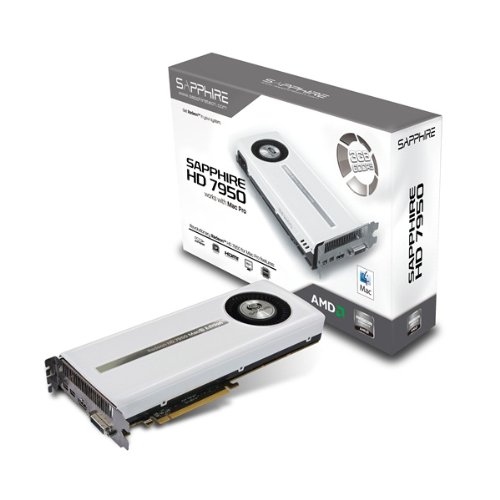
Figure 1: Sapphire Radeon HD 7950 Mac Edition Graphics Card. This image shows the overall design of the graphics card, featuring a white shroud with the Sapphire logo and 'Radeon HD 7950 Mac Edition' branding.
Key Features:
- GPU: AMD Radeon 7950, 800MHz Engine Clock
- Memory: 3GB 256-bit GDDR5, 5000MHz Effective Memory Speed
- Display Outputs: HDMI (with 3D support), 2 Mini Display Ports, Dual-link DVI-I
- Compute Power: Up to 4.3 TFLOPS Single Precision
- API Support: Open GL 4.2, Open CL 1.2, AMD HD3D Technology, APP acceleration
- Firmware: Dual Firmware support for Mac OS X/Windows (non-UEFI) and Windows (UEFI hybrid)
3. Compatibility
This graphics card is compatible with Apple Mac Pro models from 2010 and later that have an available PCI-Express x16 slot. It requires Mac OS X 10.7.5 (Lion), 10.8.2 (Mountain Lion), or later versions for full functionality. Drivers are provided for both Mac OS X and Windows operating systems.
4. Package Contents
Verify that all the following items are included in your product package:
- Sapphire Radeon HD 7950 Mac Edition Graphics Card
- DVI to VGA Adapter
- Mini-DP to DP Cable
- 2 x 6-pin power cables for Mac (250MM)
- User Manual (this document)
- Driver CD for Mac
- Driver CD for Windows
5. Setup and Installation
5.1. Physical Installation
- Power Down: Ensure your Mac Pro is completely powered off and disconnected from the power outlet.
- Open Case: Carefully open your Mac Pro's case according to Apple's instructions.
- Locate PCI-Express Slot: Identify an available PCI-Express x16 slot. The card requires two PCI-E slots in terms of physical space.
- Insert Card: Gently align the graphics card with the PCI-Express slot and press down firmly until it is securely seated. Ensure the retention clip (if present) engages.
- Connect Power: Connect the two supplied 6-pin PCI-Express power cables from your Mac Pro's power supply to the corresponding ports on the graphics card.
- Close Case: Securely close your Mac Pro's case.

Figure 2: Rear view of the Sapphire Radeon HD 7950 Mac Edition Graphics Card, showing the DVI, HDMI, and Mini DisplayPort outputs, as well as the PCI-Express connector.
5.2. Driver Installation
After physical installation, you must install the appropriate drivers for your operating system.
- Mac OS X: Insert the provided Mac driver CD. Follow the on-screen instructions to install the drivers. For optimal performance, it is recommended to check the Sapphire website for the latest driver updates compatible with your specific Mac OS X version.
- Windows: If using Windows (via Boot Camp or a separate PC architecture), insert the provided Windows driver CD and follow the installation prompts. Again, checking the Sapphire website for the most current drivers is advised.
5.3. Dual Firmware Switch
The Sapphire HD 7950 Mac Edition features a Dual Firmware (Dual BIOS) switch. This switch allows you to select the appropriate firmware for your operating environment:
- Position 1 (Mac OS X/Windows non-UEFI): This setting supports Mac OS X and Windows installations that do not utilize UEFI compliant mode. This is typically the default for older Mac Pro models.
- Position 2 (Windows UEFI Hybrid): This setting supports Windows installations with UEFI hybrid firmware enabled, often found in newer PC architectures or specific Windows setups.
Ensure the switch is set to the correct position before booting your system to avoid compatibility issues.
6. Operating Instructions
6.1. Display Configuration
The card supports flexible display configurations:
- HDMI 1.4a: Supports resolutions up to 3840 x 2160.
- Mini DisplayPort (x2): Each port supports a maximum resolution of 3840 x 2160 under MacOS X.
- Dual-link DVI-I: Supports a maximum resolution of 2560 x 1600. Can be used with older VGA monitors via the supplied adapter.
The card supports two display outputs simultaneously for dual monitor setups. For configurations involving more than two displays, especially with high resolutions, active adapters may be required for Mini DisplayPort connections. Refer to your operating system's display settings for configuration options.
7. Maintenance
To ensure the longevity and optimal performance of your graphics card, consider the following maintenance guidelines:
- Dust Removal: Periodically clean dust from the card's fan and heatsink using compressed air. Ensure the system is powered off and unplugged before cleaning.
- Airflow: Ensure adequate airflow within your Mac Pro's chassis to prevent overheating. Avoid obstructing ventilation paths.
- Driver Updates: Regularly check the Sapphire website for updated drivers to benefit from performance improvements and bug fixes.
8. Troubleshooting
If you encounter issues with your graphics card, refer to the following common troubleshooting steps:
- No Display/Black Screen:
- Verify that the graphics card is fully seated in the PCI-Express slot.
- Ensure both 6-pin power cables are securely connected to the card.
- Check that your monitor cables are correctly connected to the graphics card and the monitor.
- Confirm the Dual Firmware switch is in the correct position for your operating system.
- Try a different display output port or monitor cable to rule out faulty connections.
- Display Issues (Artifacts, Flickering, Incorrect Resolution):
- Update your graphics drivers to the latest version from the Sapphire website.
- Check your display settings in your operating system to ensure the correct resolution and refresh rate are selected.
- Ensure your monitor cables are not damaged and are securely connected.
- If using adapters, ensure they are active and compatible with your setup.
- System Instability/Crashes:
- Ensure your Mac Pro's power supply meets the minimum requirements for the graphics card.
- Monitor system temperatures to ensure the card is not overheating. Improve case airflow if necessary.
- Perform a clean installation of the graphics drivers.
- Monitor Does Not Wake from Sleep:
- This can sometimes occur due to driver or OS-specific power management settings. Ensure drivers are up to date.
- Try unplugging and re-plugging the display cable.
- Adjust power saving settings in your operating system.
9. Specifications
| Feature | Specification |
|---|---|
| GPU | AMD Radeon 7950 |
| Engine Clock | 800 MHz |
| Memory Size | 3 GB GDDR5 |
| Memory Interface | 256-bit |
| Effective Memory Speed | 5000 MHz |
| Max Screen Resolution | 2560x1600 (DVI), 3840x2160 (HDMI/Mini DP) |
| Video Output Interface | HDMI, DVI-I, 2x Mini DisplayPort |
| PCI-Express Standard | PCI-Express x16 |
| Dimensions (LxWxH) | 279mm x 110mm x 35mm (requires 2 PCI-E slots) |
| Item Weight | 4.41 pounds |
| Model Number | 11196-15-40G |
10. Warranty and Support
For information regarding product warranty, technical support, and service, please refer to the official Sapphire Technology website or contact your point of purchase. Keep your proof of purchase for warranty claims.


