
1. Introduction
The Ocean Signal SafeSea S100 is a Search and Rescue Transponder (SART) designed to assist in the location of survival craft or distressed vessels by generating a series of 12 sweeps on X-band radar. When interrogated by a ship's or aircraft's X-band radar, the S100 SART transmits a response that appears as a line of 12 dots on the radar display, indicating the position of the SART. This device is an essential piece of safety equipment for maritime use, compliant with international standards.
2. Safety Information
- Emergency Use Only: The S100 SART is intended for use in emergency situations to aid search and rescue operations. Misuse may result in penalties.
- Battery Handling: The device contains Lithium Ion batteries. Do not attempt to open the battery compartment or replace batteries unless specifically instructed by qualified personnel. Improper handling can lead to fire, explosion, or chemical burns.
- Disposal: Dispose of the SART and its batteries according to local regulations. Do not incinerate.
- Testing: Only perform self-tests as described in this manual. Excessive testing can deplete the battery.
- Magnetic Interference: Keep the SART away from strong magnetic fields that could affect its operation.
3. Package Contents
Verify that all items are present and undamaged upon unpacking:
- Ocean Signal SafeSea S100 SART Unit
- Mounting Bracket or Pole (depending on variant)
- User Manual (this document)
- 4 Lithium Ion Batteries (pre-installed or included separately)
- Test Magnet (if applicable)
4. Setup
4.1 Mounting
The S100 SART should be mounted in a readily accessible location on the vessel or survival craft, ensuring it can be quickly deployed in an emergency. It must be mounted at least 1 meter above sea level when deployed to ensure optimal radar visibility. Ensure the mounting bracket is securely fastened to a rigid surface using appropriate marine-grade fasteners.
For pole-mounted versions, ensure the pole is extended to its full height and secured to prevent collapse during deployment.
4.2 Battery Installation/Activation
The S100 SART requires 4 Lithium Ion batteries for operation. These batteries are typically included and may be pre-installed. If not pre-installed, carefully follow the instructions on the battery compartment to insert them, ensuring correct polarity. Do not activate the SART until an emergency situation arises or for a self-test.
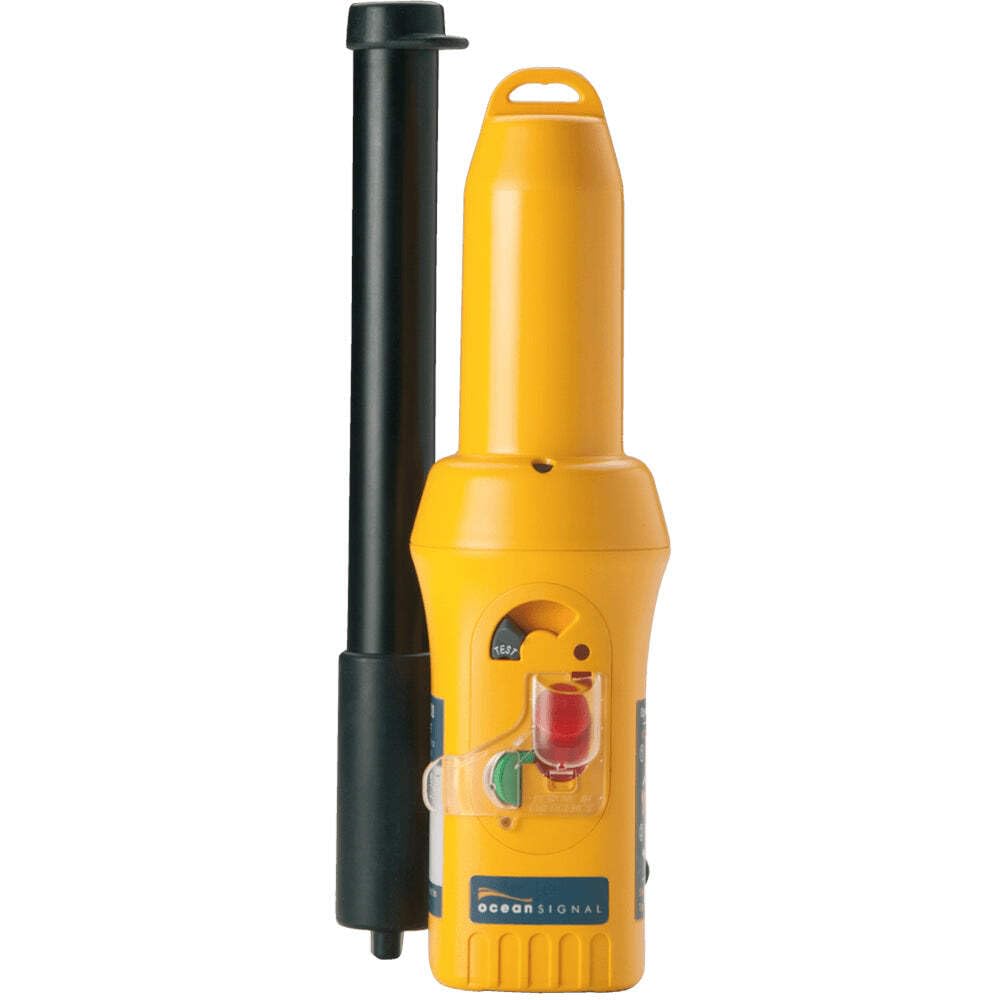
Figure 1: Ocean Signal SafeSea S100 SART unit. This image shows the compact yellow casing, designed for high visibility, with the antenna and activation switch clearly visible.
5. Operating Instructions
5.1 Self-Test Procedure
Regular self-testing ensures the SART is operational without full activation. Perform a self-test monthly or before extended voyages.
- Ensure the SART is in a safe, open area, away from other electronic equipment.
- Locate the test switch/button on the SART.
- Press and hold the test button for approximately 1-2 seconds.
- Observe the indicator light(s) and/or audible alarm. A successful test typically involves a flash of an LED and/or a short beep. Refer to the markings on your specific unit for exact indications.
- Release the test button. The SART should return to standby mode.
- If the test fails (no light/sound, or an error indication), refer to the Troubleshooting section.
5.2 Emergency Activation
In a genuine emergency, follow these steps:
- Retrieve the SART from its mounting bracket.
- Extend the antenna to its full operational length (if applicable).
- Move the activation switch to the 'ON' or 'ARMED' position. The SART will typically emit an audible alarm and/or flash an LED to indicate activation.
- Deploy the SART. It should be placed in a position where it has an unobstructed view of the horizon, ideally at least 1 meter above sea level. This can be achieved by attaching it to a survival craft's mast or a dedicated pole.
- Ensure the SART remains upright and stable to maximize its effectiveness.
5.3 Deactivation
To deactivate the SART after an emergency or accidental activation, move the activation switch back to the 'OFF' or 'STOWED' position. The indicator light and audible alarm should cease. If the SART was activated for an extended period, consider battery replacement.
6. Maintenance
6.1 Battery Replacement
The S100 SART batteries have a limited lifespan, typically 5 years, and must be replaced before their expiry date or after activation. Battery replacement should only be performed by an authorized service agent or qualified personnel. Refer to the SART's label for the battery expiry date. Do not attempt to replace batteries yourself as this may compromise the unit's watertight integrity and void the warranty.
6.2 Cleaning
Clean the exterior of the SART with a damp cloth and mild detergent. Do not use abrasive cleaners, solvents, or high-pressure water, as these can damage the casing or seals. Ensure the SART is completely dry before stowing.
6.3 Storage
Store the SART in its designated mounting bracket or a secure, dry location, away from direct sunlight and extreme temperatures. Ensure the activation switch is in the 'OFF' position to prevent accidental activation.
7. Troubleshooting
This section provides solutions to common issues. For problems not listed here, contact customer support.
| Problem | Possible Cause | Solution |
|---|---|---|
| SART fails self-test (no light/sound) | Expired or low battery; faulty unit. | Check battery expiry date. If expired or low, arrange for battery replacement by authorized service. If batteries are good, contact support. |
| Accidental activation | Switch moved inadvertently. | Immediately move the activation switch to 'OFF'. If activated for more than a few minutes, consider battery replacement. |
| SART does not deploy correctly | Mounting mechanism jammed; antenna not extending. | Inspect mounting for obstructions. Ensure regular maintenance and testing of deployment mechanism. |
8. Specifications
| Model Name | SafeSea S100 |
| Item Model Number | 710S-00607 |
| Brand | Ocean Signal |
| Item Weight | 1.7 Pounds (0.77 kg) |
| Batteries | 4 Lithium Ion batteries (included) |
| Connectivity Technology | Wired (internal components) |
| Special Feature | Emergency Radar Transponder |
| Human Interface Input | Buttons |
| Color | Yellow |
| Mounting Type | Panel Mount (or pole mount depending on variant) |
| Vehicle Service Type | Boat |
| Map Type | Nautical (for context of use) |
| Date First Available | April 3, 2011 |
9. Warranty Information
The Ocean Signal SafeSea S100 SART is covered by a manufacturer's warranty against defects in materials and workmanship. The specific terms and duration of the warranty may vary by region and purchase date. Please refer to the warranty card included with your product or visit the official Ocean Signal website for detailed warranty information and registration procedures. Keep your proof of purchase for warranty claims.
10. Customer Support
For technical assistance, service, or inquiries regarding your Ocean Signal SafeSea S100 SART, please contact Ocean Signal customer support. Contact details can typically be found on the manufacturer's official website or on the product packaging. When contacting support, please have your product model number (710S-00607) and serial number ready.
Online Resources: www.oceansignal.com