
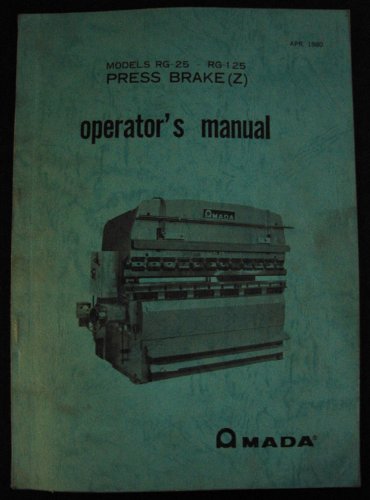
1. Introduction
This manual provides essential information for the safe and effective operation of the Amada RG-25 and RG-125 Press Brake models. It is crucial for all operators and maintenance personnel to read and understand the contents of this manual before operating or servicing the machine. Adherence to these instructions will ensure optimal performance, extend machine life, and prevent accidents.
The Amada RG-25 and RG-125 Press Brakes are precision machines designed for bending sheet metal. Proper training and understanding of the machine's capabilities and limitations are paramount.
2. Safety Information
WARNING: Failure to follow safety instructions can result in serious injury or death. Always prioritize safety.
- Always wear appropriate Personal Protective Equipment (PPE), including safety glasses, gloves, and steel-toed boots.
- Ensure all safety guards and interlocks are in place and functioning correctly before operation.
- Never place hands or body parts between the punch and die during operation.
- Perform lockout/tagout procedures before any maintenance or adjustment.
- Keep the work area clean, well-lit, and free from obstructions.
- Only trained and authorized personnel should operate or maintain the press brake.
- Understand and follow all local safety regulations and company policies.
3. Setup
Proper setup is critical for accurate bending and safe operation.
- Machine Placement: Ensure the machine is on a level, stable surface capable of supporting its weight.
- Power Connection: Connect the machine to the appropriate power supply as specified in the electrical requirements.
- Tooling Installation:
- Select the correct punch and die for the material thickness and bend angle.
- Clean the tooling and machine surfaces before installation.
- Securely install the punch in the upper beam and the die in the lower bolster, ensuring proper alignment.
- Backgauge Adjustment: Adjust the backgauge to the desired bending depth and position.
- Test Bend: Perform a test bend on scrap material to verify settings and make any necessary fine adjustments.
4. Operation
Follow these steps for safe and effective operation:
- Pre-Operation Check: Before starting, inspect the machine for any visible damage, loose parts, or oil leaks.
- Power On: Turn on the main power switch.
- Program Settings: Input or select the bending program, including bend angle, depth, and backgauge position.
- Material Loading: Carefully place the workpiece against the backgauge and ensure it is flat on the die.
- Bending Cycle:
- Activate the bending cycle using the foot pedal or control buttons.
- Maintain a safe distance from the bending area during the cycle.
- Allow the ram to complete its full cycle before removing the workpiece.
- Workpiece Removal: Carefully remove the bent workpiece.
- Emergency Stop: Familiarize yourself with the location and operation of the emergency stop button.
5. Maintenance
Regular maintenance is essential for the longevity and reliable performance of your Amada Press Brake.
- Daily Checks:
- Clean the machine and tooling.
- Check hydraulic oil level.
- Inspect for any unusual noises or vibrations.
- Weekly Checks:
- Lubricate moving parts as per the lubrication chart.
- Inspect electrical cables and connections for wear or damage.
- Monthly/Quarterly Checks:
- Check and adjust ram parallelism.
- Inspect hydraulic hoses and fittings for leaks.
- Verify the functionality of all safety devices.
- Annual Maintenance:
- Replace hydraulic oil and filters.
- Inspect and replace worn seals or gaskets.
- Have a qualified technician perform a comprehensive inspection and calibration.
Always refer to the detailed maintenance schedule provided by Amada for specific intervals and procedures.
6. Troubleshooting
This section addresses common issues that may arise during operation. For complex problems, contact Amada technical support.
| Problem | Possible Cause | Solution |
|---|---|---|
| Machine does not start | No power, emergency stop engaged, safety interlock open. | Check power supply, release emergency stop, close safety guards. |
| Inaccurate bend angle | Incorrect tooling, material springback, incorrect program settings. | Verify tooling, adjust program for springback, recalibrate settings. |
| Hydraulic oil leak | Loose fittings, damaged seals or hoses. | Tighten fittings, replace damaged components. Contact qualified personnel. |
| Excessive noise/vibration | Loose components, worn bearings, hydraulic issues. | Inspect and tighten, check lubrication, consult maintenance guide. |
7. Specifications
The Amada RG-25 and RG-125 Press Brakes are designed for robust performance. Specific technical data may vary by exact model year and configuration. Please refer to your machine's data plate for precise specifications.
- Model: RG-25 / RG-125
- Manufacturer: Amada
- Type: Hydraulic Press Brake
- Bending Capacity: (Varies by model, e.g., RG-25: 25 tons, RG-125: 125 tons)
- Bending Length: (Varies by model, e.g., RG-25: 1250 mm, RG-125: 3000 mm)
- Power Supply: 3-Phase, Voltage and Frequency as per regional standards (e.g., 400V, 50Hz)
- Weight: (Varies significantly by model, e.g., RG-25: approx. 2,000 kg, RG-125: approx. 8,000 kg)
Note: The "Item weight: 368 g" mentioned in product data refers to the weight of this physical manual, not the machine itself.
8. Warranty and Support
For information regarding warranty coverage, technical support, spare parts, or service requests, please contact your authorized Amada dealer or the official Amada customer service department. Ensure you have your machine's serial number and model information available when contacting support.
Unauthorized modifications or repairs may void your warranty and compromise machine safety. Always use genuine Amada replacement parts.


