
1. Overview of the Factory Assembly Manual
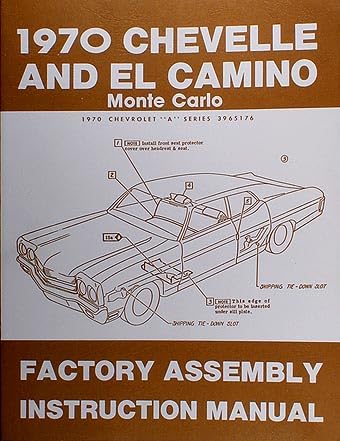
This document serves as an instruction guide for the 1970 Chevrolet Chevelle, El Camino, and Monte Carlo Factory Assembly Instruction Manual. This manual is a comprehensive resource designed to provide detailed assembly illustrations for various components of the specified 1970 Chevrolet models. It is an invaluable tool for individuals involved in the restoration, maintenance, or repair of these classic vehicles.
The original manual was produced for internal factory use and has been reprinted to assist enthusiasts and professionals. It offers an in-depth look at how these vehicles were originally assembled, down to individual nuts, bolts, and screws.
2. Content Details
The Factory Assembly Instruction Manual contains extensive information across 915 pages, covering a wide range of vehicle systems and components. Key areas of coverage include:
- Body Assembly & Mounting: Detailed diagrams for the vehicle's body structure.
- Frame: Illustrations pertaining to the chassis and frame components.
- Front & Rear Suspension: Comprehensive views of suspension systems.
- Brakes: Assembly details for the braking system.
- Engine & Transmission: Exploded views of powertrain components.
- Fuel & Exhaust: Diagrams for fuel delivery and exhaust systems.
- Steering: Assembly instructions for steering mechanisms.
- Wheels & Tires: Information related to wheel and tire installation.
- Sheet Metal: Details on body panels and associated components.
- Electrical: Wiring diagrams and electrical component placement.
- Radiator & Grille: Assembly of cooling system and front fascia.
- Bumpers: Installation and component breakdown of bumpers.
- Accessories & Options: Includes details on items such as radio and speakers, roof luggage carrier, and cowl inducted hood.
The manual also features part group numbers, wiring diagrams, torque specifications, and handwritten revision records, providing a complete historical and technical reference.
3. Usage Guidelines
This assembly manual is intended to facilitate various tasks related to the 1970 Chevrolet Chevelle, Monte Carlo, and El Camino:
- Disassembly and Reassembly: Use the exploded views and illustrations to guide the correct removal and installation of vehicle components.
- Part Identification: The detailed diagrams and part group numbers assist in identifying correct or missing parts during restoration or repair.
- Restoration Projects: Provides critical information for ensuring historical accuracy in restoration efforts, covering both base models and fully loaded configurations.
- Technical Reference: Consult for wiring diagrams, torque specifications, and original factory assembly methods.
It is recommended to review relevant sections thoroughly before commencing any work on the vehicle.
4. Manual Specifications
| Publisher | Chevrolet |
| Original Publication Date | January 1, 1970 |
| Language | English |
| Print Length | 915 pages |
| Item Weight | 3.5 pounds |
| Dimensions | 11 x 8.25 x 1.4 inches |
5. Important Notes
As this manual is a reproduction of a document originally created for factory use and not for public distribution, some characteristics of the original may be present in the reprint:
- Print Quality: The print quality, similar to original assembly manuals, may occasionally appear light in certain sections. This is a characteristic of the source material and not a defect in the reproduction.
- Content Scope: This manual specifically covers the 1970 Chevrolet Chevelle, Monte Carlo, and El Camino models. It does not extend to other model years or vehicle types.
6. Support and Further Information
For additional support or inquiries regarding the content of this assembly manual, it is recommended to consult automotive restoration forums, specialized Chevrolet enthusiast communities, or professional automotive historians. These resources can often provide supplementary information, clarifications, or practical advice based on experience with these specific vehicle models.
While this manual is a comprehensive guide, practical application may require additional research or expert consultation for complex restoration challenges.


