
Introduction
Thank you for purchasing the Pyle PLA-2180 600-Watt 2-Channel Bridgeable MOSFET Amplifier. This manual provides essential information for the proper installation, operation, and maintenance of your amplifier. Please read it thoroughly before use to ensure optimal performance and safety.
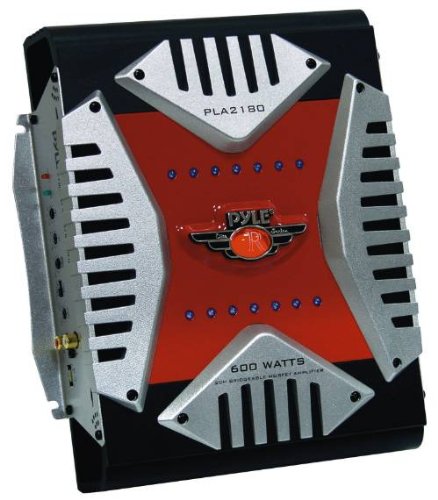
Image: Front view of the Pyle PLA-2180 amplifier, showcasing its red and silver design with the Pyle logo and model number.
Safety Instructions
To prevent injury or damage to the amplifier, please observe the following safety precautions:
- Ensure proper grounding of the amplifier to the vehicle chassis.
- Disconnect the vehicle's battery before making any electrical connections.
- Use appropriate gauge wiring for power, ground, and speaker connections as specified in the installation section.
- Avoid mounting the amplifier in locations exposed to direct sunlight, excessive heat, moisture, or dust.
- Do not open the amplifier casing. Refer all servicing to qualified personnel.
- Ensure adequate ventilation around the amplifier to prevent overheating.
Features
The Pyle PLA-2180 amplifier is designed with the following key features:
- 300 Watts x 2 Output (Stereo Mode)
- 600 Watts x 1 Bridged Output (Mono Mode)
- Variable High/Low Electronic Crossover Network
- Variable Bass Boost (0 - 18dB at 60Hz)
- Variable Input Level (Gain) Control
- Gold-Plated RCA Inputs for optimal signal transfer
- Thermal Overload and Short Circuit Protection for enhanced durability
Installation
Proper installation is crucial for the performance and longevity of your amplifier. If you are unsure about any steps, consult a professional installer.
Mounting Location
- Choose a dry, well-ventilated location away from direct heat sources.
- Ensure sufficient space around the amplifier for air circulation.
- Securely mount the amplifier to a solid surface using appropriate hardware.
Wiring Connections
- Power Connection: Connect a heavy-gauge power cable (e.g., 8-gauge or larger) from the vehicle's positive battery terminal to the amplifier's +12V terminal. Install an in-line fuse holder (rated appropriately for the amplifier's current draw) within 18 inches of the battery.
- Ground Connection: Connect a heavy-gauge ground cable of the same length as the power cable from the amplifier's GND terminal to a clean, unpainted metal surface on the vehicle chassis. Ensure a solid, low-resistance connection.
- Remote Turn-On: Connect a remote turn-on wire (e.g., 18-gauge) from your head unit's remote output to the amplifier's REM terminal. This wire turns the amplifier on and off with your head unit.
- RCA Input: Connect RCA cables from your head unit's pre-amp outputs to the amplifier's RCA INPUT jacks.
- Speaker Output: Connect your speakers to the amplifier's speaker terminals. Observe correct polarity (+ to + and - to -). For bridged operation, refer to the diagram on the amplifier or consult a professional.
Operation
Once installed, the amplifier's settings can be adjusted to optimize sound performance.
Controls
- Gain Control (Input Level): This control matches the amplifier's input sensitivity to the output level of your head unit. Start with the gain at minimum, then slowly increase it until you hear distortion, then back off slightly.
- Crossover (HPF/LPF): The variable high-pass filter (HPF) and low-pass filter (LPF) allow you to direct specific frequency ranges to your speakers. Adjust these settings based on your speaker type (e.g., LPF for subwoofers, HPF for full-range speakers).
- Bass Boost: This control provides an adjustable bass enhancement at 60Hz. Use sparingly to avoid distortion and speaker damage.
Maintenance
The Pyle PLA-2180 amplifier requires minimal maintenance to ensure long-term performance.
- Keep the amplifier clean and free from dust. Use a soft, dry cloth for cleaning.
- Ensure all connections remain secure and free from corrosion. Periodically check wiring for any signs of wear or damage.
- Do not use harsh chemicals or abrasive cleaners on the amplifier's surface.
Troubleshooting
If you experience issues with your amplifier, refer to the following table for common problems and solutions.
| Problem | Possible Cause | Solution |
|---|---|---|
| No Power / Amplifier does not turn on | Blown fuse Poor power/ground connection No remote turn-on signal | Check and replace fuse Verify all power and ground connections are secure Check remote wire connection and head unit output |
| No Sound Output | RCA cables disconnected/damaged Speaker wires disconnected/shorted Gain set too low | Check RCA connections Inspect speaker wiring for shorts or disconnections Increase gain control gradually |
| Distorted Sound | Gain set too high Poor ground connection Speaker impedance mismatch | Reduce gain control Verify ground connection Ensure speakers are compatible with amplifier's impedance rating |
| Amplifier Overheating | Insufficient ventilation Low impedance load Sustained high output | Ensure adequate airflow around amplifier Check speaker impedance Reduce volume or gain settings |
Specifications
Detailed technical specifications for the Pyle PLA-2180 amplifier:
| Feature | Specification |
|---|---|
| Brand | Pyle |
| Model | PLA-2180 |
| Number of Channels | 2 |
| Maximum Output Power | 600 Watts (Bridged) |
| Output Power (Stereo) | 300 Watts x 2 |
| Crossover Network | Variable High/Low Electronic |
| Bass Boost | 0 - 18dB at 60Hz |
| Input Level Control | Variable |
| Input Connectors | Gold-Plated RCA |
| Protection Features | Thermal Overload, Short Circuit |
| Product Dimensions (L x W x H) | 30.5 x 12.7 x 35.6 cm (approx. 12 x 5 x 14 inches) |
| Item Weight | 3.92 kg (approx. 8.64 lbs) |
| UPC | 068888722988 |
Warranty and Support
Pyle products are designed for reliability and performance. This product is covered by a standard manufacturer's warranty against defects in materials and workmanship. Please refer to the warranty card included with your purchase or visit the official Pyle website for specific warranty terms and conditions.
For technical support, troubleshooting assistance, or warranty claims, please contact Pyle customer service through their official website or the contact information provided with your product documentation.


