
Hersant B0000CMGON
User Guide: The LZ 129 'Hindenburg'
Famous Aircraft Series
Introduction
This guide provides an overview of the publication "The LZ 129 'Hindenburg' (Famous aircraft series)" by Douglas H. Robinson. This book serves as a detailed resource on the iconic German rigid airship, the LZ 129 Hindenburg, covering its design, operational history, and significance.
The publication is intended for enthusiasts of aviation history, researchers, and anyone interested in the era of large airships. It offers insights into one of the most famous aircraft in history.
About the LZ 129 'Hindenburg'
The LZ 129 Hindenburg was a large German commercial passenger-carrying rigid airship, the lead ship of the Hindenburg class, and the longest flying machine and the largest airship by envelope volume. It was designed and built by the Zeppelin Company (Luftschiffbau Zeppelin GmbH) on the shores of Lake Constance in Friedrichshafen, Germany.
This section of the book provides foundational knowledge about the airship, including its historical context and the vision behind its creation as a symbol of German engineering prowess and a means of transatlantic travel.
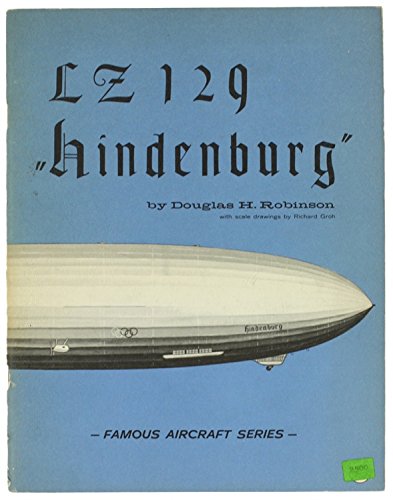
This image displays the front cover of the book 'The LZ 129 Hindenburg (Famous aircraft series)'. The cover features the title 'LZ 129 Hindenburg' prominently, along with the author 'Douglas H. Robinson' and illustrator 'Richard Groh'. A large illustration of the Hindenburg airship is visible across the lower half of the cover, set against a light blue background. The series title '- FAMOUS AIRCRAFT SERIES -' is also present at the bottom.
Design and Construction
The book delves into the intricate details of the Hindenburg's design and construction. It covers the structural framework, the duralumin girders, the gas cells, and the outer fabric covering. Emphasis is placed on the engineering innovations that allowed for such a massive airship to be built and operated.
Key aspects discussed include:
- The internal structure and materials used.
- The propulsion system, including the Daimler-Benz diesel engines.
- Passenger accommodations and crew facilities.
- Aerodynamic considerations and control surfaces.
Richard Groh's scale drawings provide visual clarity to these complex technical descriptions.
Operational History
This section of the book chronicles the Hindenburg's operational life, from its maiden flight in March 1936 to its final voyage. It details the transatlantic passenger services between Germany and North and South America, highlighting the luxury and speed of airship travel during that era.
The narrative includes accounts of significant flights, passenger experiences, and the routine operations involved in managing such a large airship. It also touches upon the challenges and successes encountered during its brief but impactful service period.
Key Features and Specifications
The book provides detailed specifications of the LZ 129 Hindenburg, offering a comprehensive technical profile of the airship. These specifications are crucial for understanding the scale and engineering marvel of the Hindenburg.
| Feature | Detail |
|---|---|
| Length | 245 meters (803 ft 10 in) |
| Diameter | 41.2 meters (135 ft 2 in) |
| Gas Volume | 200,000 m³ (7,062,000 cu ft) of hydrogen |
| Engines | 4 × Daimler-Benz DB 602 diesel engines, 1,200 hp each |
| Max Speed | 135 km/h (84 mph) |
| Cruising Speed | 122 km/h (76 mph) |
| Range | 16,000 km (9,900 mi) |
| Payload | Approx. 10,000 kg (22,000 lb) |
| Crew | 40-61 |
| Passengers | 50-72 |
These details provide a clear understanding of the Hindenburg's capabilities and its position as a leading example of airship technology.
Historical Significance and Legacy
The book dedicates a significant portion to the Hindenburg disaster of May 6, 1937, at Naval Air Station Lakehurst, New Jersey. This tragic event marked a turning point in the history of airship travel, leading to the decline of large rigid airships for passenger transport.
Beyond the disaster, the publication explores the broader legacy of the Hindenburg, its impact on aviation safety regulations, and its enduring presence in popular culture and historical memory. It examines how the Hindenburg symbolized both the pinnacle of airship technology and the inherent risks associated with hydrogen-filled aircraft.
About the Authors
Douglas H. Robinson is the author of this volume. His expertise in aviation history provides the authoritative text for this detailed account of the Hindenburg.
Richard Groh is credited with the scale drawings featured throughout the book. His illustrations are integral to understanding the technical aspects and visual details of the LZ 129 Hindenburg.
Further Information
For additional details or inquiries regarding this publication, please refer to the publisher, Hersant. The book's ASIN is B0000CMGON.
This book is part of the "Famous Aircraft Series," which aims to document significant aircraft throughout history. For more titles in this series, please consult the publisher's catalog or relevant historical aviation resources.