
1. Introduction to Shadowrun Fifth Edition
Welcome to the Sixth World, a dystopian near-future where magic has returned, megacorporations rule, and technology merges with flesh. Shadowrun Fifth Edition is a tabletop role-playing game that immerses players in a world of high-tech heists, arcane rituals, and dangerous street-level operations. This manual provides the essential rules and guidelines for creating characters, understanding game mechanics, and navigating the complex realities of the Shadowrun universe.
As a player, you will assume the role of a shadowrunner, a denizen of the urban sprawl who operates outside the law, taking on dangerous jobs for powerful clients. As a Game Master (GM), you will guide players through thrilling narratives, adjudicate rules, and bring the vibrant, dangerous world of Shadowrun to life.
2. What is Shadowrun Fifth Edition?
Shadowrun Fifth Edition is a comprehensive role-playing game that combines elements of cyberpunk and urban fantasy. It features a detailed setting where elves, dwarves, orks, and trolls live alongside humans, and magic coexists with advanced technology. The game's core mechanics revolve around dice pools, where players roll a number of six-sided dice (d6) to determine the success of their actions.
The rulebook covers all aspects of gameplay, from character creation and combat to the intricacies of hacking the global computer network (the Matrix) and manipulating magical energies. It is designed for both new players to the Shadowrun universe and veterans of previous editions, offering a refined and updated ruleset.

Image 1: The cover of the Shadowrun Fifth Edition Core Rulebook. It depicts several shadowrunners in action within a futuristic, neon-lit cityscape, showcasing the blend of magic and technology central to the game's theme.
3. Core Concepts and Setup
Before beginning a game of Shadowrun Fifth Edition, players and the Game Master should familiarize themselves with the core concepts:
- The Sixth World: Understand the setting's history, major factions (megacorporations, governments, criminal syndicates), and the return of magic.
- Dice Pools: Most actions are resolved by rolling a pool of d6s. Each die showing a 5 or 6 is a 'hit'. The number of hits determines success.
- Attributes and Skills: Characters are defined by eight attributes (e.g., Body, Agility, Logic) and numerous skills (e.g., Athletics, Firearms, Hacking).
- Karma: A meta-currency used for character advancement and sometimes to influence dice rolls.
- Initiative: Determines turn order in combat and other time-sensitive situations.
Required Materials: To play, you will need:
- The Shadowrun Fifth Edition Core Rulebook.
- Six-sided dice (d6), preferably a large quantity (10-20 per player).
- Character sheets and pencils.
- A group of 3-6 players, including one Game Master.
4. Character Creation
Creating a shadowrunner is a fundamental part of the game. The Fifth Edition uses a Priority System, allowing players to allocate resources across different categories to build their unique character concept.
4.1. Priority System
Players choose a priority (A, B, C, D, E) for five categories:
- Metatype: Determines your character's race (Human, Elf, Dwarf, Ork, Troll) and associated special abilities and attribute limits.
- Attributes: Allocates points to your character's core physical and mental statistics.
- Magic/Resonance: Determines if your character is a magician, adept, technomancer, or mundane, and the strength of their magical or resonance abilities.
- Skills: Provides skill points to specialize in various abilities like combat, stealth, or social interaction.
- Resources: Grants starting Nuyen (currency) and equipment.
4.2. Character Details
Beyond priorities, players define their character's qualities (positive and negative traits), contacts, and backstory. Cyberware and bioware augmentations can be purchased with starting resources, enhancing physical or mental capabilities at the cost of Essence.
5. Game Mechanics (Operating)
Shadowrun Fifth Edition's gameplay is driven by a robust set of mechanics:
- Tests: When a character attempts an action with an uncertain outcome, they make a test. This typically involves rolling a dice pool equal to an Attribute + Skill rating.
- Thresholds: Many tests require a minimum number of hits (a threshold) to succeed.
- Limits: All tests are subject to a limit, which caps the maximum number of hits that can be counted. Limits are usually derived from an attribute or piece of gear.
- Opposed Tests: When two characters directly oppose each other, both roll a dice pool, and the one with more hits succeeds.
- Edge: A special resource that can be spent to gain advantages, such as rerolling dice or increasing limits.
6. Magic and The Matrix
These two distinct systems represent the supernatural and technological pillars of the Shadowrun world.
6.1. Magic
Magicians can cast spells, summon spirits, and perceive the astral plane. Adepts enhance their physical and mental abilities with magical energy. The magic system involves choosing traditions, learning spells, and managing drain (the physical or mental toll of using magic).
6.2. The Matrix
The Matrix is the global computer network, a virtual reality accessed by deckers and technomancers. Deckers use specialized cyberdecks to hack into systems, bypass security, and extract data. Technomancers are individuals who can interface with the Matrix directly using their minds, without the need for technology. Matrix actions include hacking, spoofing, data spiking, and defending against intrusion.
7. Combat
Combat in Shadowrun is fast-paced and lethal. It is resolved in Initiative Passes, with characters taking turns based on their Initiative Score.
- Initiative: Determined by rolling 1d6 for each point of Reaction + Intuition, plus a base score. Higher scores act earlier.
- Actions: Characters can take a Simple Action and a Complex Action, or two Simple Actions, during their turn.
- Attack Tests: Typically Agility + Weapon Skill for ranged attacks, or Agility + Close Combat Skill for melee attacks, opposed by the defender's Reaction + Intuition.
- Damage: Successful attacks inflict physical or stun damage, which can quickly incapacitate or kill a character. Armor and damage resistance tests reduce incoming damage.
- Healing: Characters can recover from damage through natural healing, magical healing, or medical attention.
8. Game Master's Guide
The Game Master (GM) is responsible for running the game, narrating the story, portraying non-player characters, and adjudicating rules. This section provides guidance for GMs.
- Storytelling: Develop compelling plots, intriguing mysteries, and challenging scenarios for the players.
- Pacing: Manage the flow of the game, balancing action, investigation, and role-playing.
- Rules Adjudication: Interpret and apply the rules fairly and consistently. When in doubt, prioritize narrative flow and fun.
- World Building: Expand upon the provided setting, creating unique locations, characters, and challenges.
- Balancing Encounters: Design combat and social encounters that are challenging but not insurmountable for the player characters.
9. Troubleshooting and Common Questions
Even with a comprehensive rulebook, questions and challenges may arise during gameplay. Here are some common issues and approaches to resolve them:
- Rules Disputes: If a rule is unclear, the GM makes a ruling to keep the game moving. Discuss the rule further between sessions. Many online forums and communities offer clarifications.
- Player Engagement: If a player seems disengaged, try to incorporate their character's backstory or skills into the current scenario. Encourage role-playing and provide opportunities for all characters to shine.
- Balancing Challenges: If encounters are too easy or too difficult, adjust on the fly. Add or remove enemies, modify their stats, or introduce environmental factors. Learn from each session to better balance future challenges.
- Pacing Issues: If the game feels slow, introduce a time limit, a sudden complication, or a new threat. If it's too fast, allow for more role-playing, investigation, or downtime activities.
Remember that the goal is to have fun. Communication between players and the GM is key to a successful game.
10. Specifications
Key details regarding the Shadowrun Fifth Edition Core Rulebook:
| Specification | Detail |
|---|---|
| Publisher | Catalyst Game Labs |
| Publication Date | January 1, 2013 |
| Edition | Fifth Edition |
| Language | English |
| Print Length | 476 pages |
| ISBN-10 | 1936876515 |
| ISBN-13 | 978-1936876518 |
| Item Weight | 3.75 pounds |
| Dimensions | 8.74 x 1.3 x 10.91 inches |
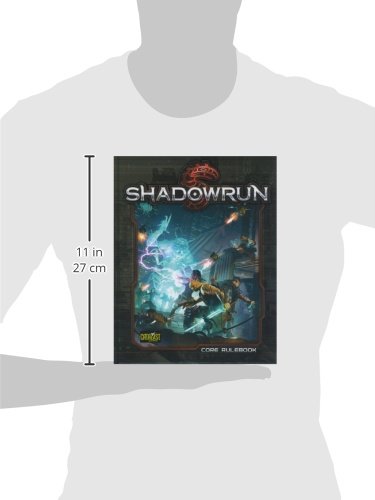
Image 2: A visual representation of the Shadowrun Fifth Edition Core Rulebook's dimensions, showing its approximate size relative to a person's hands, indicating a height of 11 inches (27 cm).
11. Additional Resources and Support
For further assistance, community engagement, and official updates, consider the following resources:
- Official Catalyst Game Labs Website: Visit the publisher's website for errata, FAQs, and news regarding Shadowrun products.
- Shadowrun Community Forums: Engage with other players and GMs on official or fan-run forums. These communities often provide valuable insights, house rules, and answers to specific rules questions.
- Supplements: Explore additional rulebooks and sourcebooks published for Shadowrun Fifth Edition to expand your game with new options, lore, and adventures.
12. Warranty Information
As a rulebook, Shadowrun Fifth Edition does not typically come with a functional warranty for gameplay. However, for issues related to print quality, binding defects, or missing pages, please contact Catalyst Game Labs directly or the retailer from whom the book was purchased. Retain your proof of purchase for any such claims.