
Introduction and Overview
This manual provides comprehensive information on every aspect of the K9 unit, from administration to officer safety on the job. Drawing from two decades of experience, it presents expert training exercises and deployment procedures. It also examines the attitudes of law enforcement officers from both within and outside the K9 team and analyzes how this affects officer performance and morale.
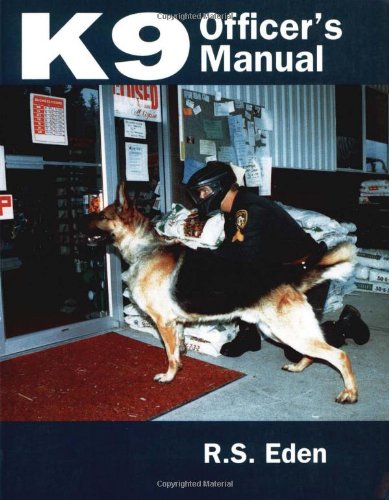
Image: The cover of the K9 Officer's Manual, featuring a police K9 unit. This image illustrates the primary subject matter of the manual.
K9 Administration
Law enforcement agencies organize and operate their K9 units with varying approaches. A common factor across most departments in the United States and Canada is that budget constraints frequently impact the dog section first. This directly affects the officers' ability to perform successfully and impacts the safety of both K9 handlers and the line officers they support.
Budget Constraints
Budget constraint is an unavoidable challenge for any agency. While cutting costs is difficult across all sections, the K9 section presents a unique liability factor. If K9 units are deployed, the department's potential for lawsuits is considerable if teams lack up-to-date training. Therefore, K9 section training budgets, including courses, in-service training, and associated equipment, should not be conservative. Limiting these budgets increases program and departmental risk.
Record Keeping
Consistent and regular work is essential for any police service dog to maintain efficiency across all training areas. While a full-time training program is ideal, smaller departments may not have the budget. At a minimum, weekly in-service training programs are required for K9 teams to remain proficient. Given current liability concerns, administrators responsible for a dog unit must prioritize training and record keeping. This record keeping must document all weekly in-service training necessary for basic proficiency. Approximately 35% to 40% of a K9 team's in-service time should be dedicated to training to maintain minimum standards. Agencies failing to provide adequate training time put officers at risk and face high departmental liability.
Thorough record keeping is paramount. Accurate training records are the initial step in a series of documents a dog unit should maintain. Every deployment, regardless of success, requires a report detailing the application and circumstances. Any use of force by the dog on a suspect must be documented; if physical contact occurs, the injury site should be photographed and filed. Well-defined deployment records provide pertinent data for court purposes and can reveal patterns for the unit's head trainer. By analyzing deployment reports over time, training officers can identify weaknesses in specific dog teams' training. For example, a high failure rate on tracking applications with time delays over ten minutes or temperatures above 15.5 degrees Celsius (60 degrees Fahrenheit) might indicate a dog lacking stamina, requiring targeted training. Health records for each dog are also vital for tracking vaccinations and medical checkups, protecting the department. While record keeping can be cumbersome, it serves as the best defense against liabilities. However, it is a double-edged sword, as all documentation can be subpoenaed by defense counsel or litigation attorneys. Officers should write reports with this in mind.
K9 Training Schools
Abbreviated Training Schools
Administrators in the United States often send officers to abbreviated training programs to cut costs, reasoning they cannot afford a twelve- to sixteen-week program due to the officer's absence from duty. This approach leads to numerous common problems, often resulting in lost time and double the intended investment. The following case study exemplifies issues arising from attempts to cut financial corners.
Case Study: Inadequate Training Outcomes
An officer contacted me regarding problems with his dog. His department had purchased a dog and sent it to a private training facility. After the dog's training, the officer attended a three-week handler course. Upon reviewing a video, I expressed doubts about the dog's street workability. The team encountered immediate problems on the street. The officer, new to dog handling, relied solely on the facility's judgment, lacking the knowledge to resolve issues independently. He had not undergone a comprehensive training program that taught problem evaluation and dog training, only rudimentary handling of an already trained animal.
The dog worked for a year without making physical contact with any suspect. While its tracking ability was excellent, its reluctance to engage suspects caused the handler significant concern. A serious incident occurred where the dog abandoned him during a dangerous confrontation, failing completely. The officer feared reporting the dog's unworkability would lead to program shutdown. Consequently, the dog was removed, and the officer was sent to another training program with a new dog.
Private Agencies
Many dogs sold to police K9 programs in North America are imported from overseas suppliers by private agencies. Upon arrival in the United States or Canada, importing agents often lack knowledge of the animal's history. Due to high demand, these agencies frequently locate, train, and sell dogs rapidly. Even with minimal turnaround, they struggle to meet demand. Fortunately, most companies are reputable and dedicate sufficient time to the dog before placement with a law enforcement agency.
Handler Candidates
Once a dog is ready, the police department sends a candidate officer for training. Often, the officer is chosen for their interest in the program or high street productivity. However, these qualifications do not always equate to a good dog handler. While desire is present, the officer may lack the personality type suitable for handling. An experienced dog trainer can assist in this judgment.
An officer attending a brief program receives minimal training. Due to time constraints, they acquire only a small portion of the necessary training. This limitation means the officer learns only basic handling skills, with insufficient time to learn how to train a dog. Experienced K9 officers understand that proper dog work requires adequate basic training as a foundation. If a training problem, such as control work, arises later, the officer lacks the knowledge to correct it, necessitating a return to the training center, which incurs further expense and takes the team off duty. Ignoring the problem due to budget constraints exposes the department to potential lawsuits. Thus, a short handler's course with a pre-trained dog may not be suitable. Abbreviated programs are ideal for officers who have completed a full training program and have years of street experience, allowing them to benefit from reduced training time while upgrading their skills.
Training vs. Handling
There is a distinct difference between training a dog and handling a dog. A well-trained dog can be handled by providing appropriate direction and working with the animal. However, an officer cannot train a dog simply by learning how to handle it. A proficient dog handler must understand canine thought processes, interpret dog behavior, and fully comprehend how to communicate with their dog and how the dog communicates back. This understanding is a prerequisite for tactical training, as every action of the dog provides information about the situation. Subtle body movements can signal imminent danger to a well-trained officer. The only way to acquire the necessary communication skills with their partner is for the officer to train the dog from the beginning.
The officer needs to learn how to select an untrained dog, temperament test it for law enforcement use, and then train it. Upon completing a full program, the officer gains the ability to address most problems arising in the dog's performance without needing to return to the agency where the dog was purchased.
Full Training Programs
If an officer encounters training problems with their dog, many departments' only recourse is corrective training at the facility where the dog was acquired. While the selling agency employs qualified trainers who can resolve issues and return the team to duty, this approach is neither productive nor cost-effective. Enrolling the officer in a full training program offers long-term savings and produces superior street teams compared to those who have only received a basic handler's program. A full training program also enables the officer to learn advanced tactical training crucial for a K9 team. The necessity of comprehensive and proper training, including officer survival techniques, cannot be overstated. A successful team will encounter more armed suspects and face higher risks due to its success rate. Therefore, denying a team appropriate training is reprehensible. If using a private vendor, send your officer to a training facility that offers a full training program, allowing them to learn dog training from the basics up.
Apprehension Techniques
Reasonable Force vs. Handler Control
The debate between standard handler-control training and reasonable-force work has complicated the dangers of civil litigation. Reasonable force, also known as minimum force or "circle and bark," has generated significant controversy regarding police dog deployment. It is a misconception that using reasonable-force dogs alleviates lawsuits. Numerous lawsuits have arisen from police dog applications involving victims needlessly attacked by service dogs. While the lawsuit may stem from a dog bite, the handler's judgment and training will be the focus of attorneys' cross-examinations. When K9 application is justified, every court in North America to date has upheld the use of handler-control techniques.
Reasonable-force dogs, both in theory and in practice within some departments, perform effectively as street dogs, maintaining a low bite ratio on suspects, which appeals to department administrations. However, extensive training hours are required for reasonable-force dog teams to keep the dogs sufficiently "clean." This implies that if training is not proper and consistent, the dog may begin to bite in street applications when unwarranted. Agencies acquiring pre-trained Schutzhund-based dogs are more susceptible to training difficulties and face a high risk of liability. Schutzhund dogs are trained for sporting events with an emphasis on control work in a sterile, predictable environment where the dog is conditioned for consistent responses. Scenarios remain unchanged, and the same response is expected. Street situations, however, vary with each dog application. Schutzhund conditioning, if extended to advanced phases, creates difficulties when converting the dog to police work. Given the diverse requirements of police work, trainers often must "untrain" the dog to make it useful. If the dog has advanced Schutzhund training, this retraining can be challenging, and in real-life applications, the dog may revert to its original training, potentially leading to a deadly situation on the street.
When selecting potential candidates, Schutzhund-based dogs are excellent prospects for police work if acquired before training surpasses a Schutzhund I level. Beyond this level, specific difficulties can arise for law enforcement trainers. If your department mandates a reasonable force policy, contact an agency running a successful police-oriented reasonable force program based on German police training methods. Two excellent programs at the time of this writing are run by Wendell Nope at the Utah POST Academy in Salt Lake City, Utah, and Terry Rogers of the Denver Police Department K9 Unit.
Theory of Reasonable Force
The theory of reasonable-force dogs posits that if a suspect surrenders, the dog will not bite, and the dog frequently decides whether to bite. Depending on the level of basic training and in-service work, this may or may not hold true. A dog cannot reason out a suspect's intentions; it only reacts to conditioned circumstances. If improperly conditioned, it will bite when unwarranted or fail to bite when most needed. No trainer can condition a dog for every conceivable action or reaction encountered on the street, which limits reasonable-force teams.
A handler employing handler-control apprehension methods, given the same circumstances as a reasonable-force dog, will direct their dog to bite only when necessary. If circumstances do not warrant a bite, the handler calls the dog off, orders it to guard the suspect, and proceeds with the arrest. With a reasonable-force dog, when circumstances warrant a bite, the dog will bite and hold the suspect until called off. If the situation does not warrant a bite, the dog continues to harass the suspect until the officer intervenes for arrest.
With handler-control, the decision for the dog to physically apprehend a suspect by biting is made by the handler, who must remain in sight of the dog. The reasonable-force dog, conversely, makes that decision independently based on a perceived threat, even if not under direct handler supervision. The key difference between a reasonable-force dog and a handler-controlled dog is that the latter is always under direct handler supervision. The marketing of reasonable-force methods appears, in retrospect, to be a strategy sold to administrations to compensate for past problems. Instead of writing appropriate policies, being more cautious in handler selection, staying current with training techniques, and holding handlers accountable, the trend has been to allow the dog to decide and train it not to bite unless the suspect shows obvious aggression or attempts escape. Unfortunately, not all suspects using deadly force on police dogs and officers do so aggressively enough for a reasonable-force dog to discern intent in time to avert tragedy.
Bite Ratios
Statistical analysis of bite ratios can be misleading and manipulated to yield desired results. Statistics comparing agencies often fail to account for mitigating circumstances, such as incomparable crime rates or the inclusion of violent versus non-resisting property crime suspects. A recent report from a major city police department's research and development office investigated changing policy from bite-and-hold to reasonable-force applications. The research involved a comprehensive questionnaire sent to various departments regarding policies and procedures, querying agencies using both methods about lawsuits from dog apprehensions. Surprisingly few were reported. However, at the time, more lawsuits were against reasonable-force departments than handler-control. The agency conducting the research has, to date, maintained its handler-control policy.
Liability
Liability for any dog bite rests with the handler, their supervisors, and the department. Therefore, policy must detail deployment circumstances and required officer procedures. Generally, this policy states that an officer's use of force with their dog must adhere to reasonable-force guidelines and jurisdictional laws. Officer and public safety must be paramount. Documentation for each application must be detailed and complete, including injury extent, circumstances leading to dog application, and victim medical follow-up. Liability for a dog bite is no greater than for misuse of a handgun, baton, or any other law enforcement control device. Application of these weapons must follow strict departmental SOP guidelines.
Minimizing Liability
Both handler-control and reasonable-force training styles have merit. If reasonable-force applications are mandated, understand they will not minimize liability more than a properly trained handler-control team. Regardless of the apprehension technique, the potential for lawsuits remains. Liability can only be minimized when the dog is applied using clearly defined standard operating procedures, enforced by close supervision and documentation.
K9 Applications For Emergency Response Team (ERT)
Integrating K9 Teams and ERT
Modern law enforcement requires police dogs in ERT applications. Many proactive departments integrate K9 teams into ERT situations as an essential part of their operations. However, many more departments have attempted to incorporate dogs into ERT training only to experience significant failures. There are diverse opinions among departments regarding dog applications in emergency response tactics. Some departments excel in combined operations, while others fail so severely that administrators vow never to combine K9 and ERT again. From an experienced K9 handler's perspective, the solutions are straightforward. To an administrator or tactical team member with only basic knowledge of how a dog works, these answers can be difficult to grasp. To dispel misconceptions about ERT and K9, the simple fact is that K9 can be a very useful and integral part of an ERT team. There are limitations, and for success, every administrator, K9 handler, and team member must be aware of them. Law enforcement agencies deciding to use K9 teams with ERT must carefully approach their programs. A good patrol dog team does not automatically make a good team for dynamic door entries. One major reason K9 and ERT programs fail is due to improper team selection.
Any good K9 handler will be interested in working with ERT, as it offers an exciting challenge and diversification. Every dog handler I've met thrives on the action that comes from working the dog. However, this enthusiasm can sometimes hinder objective decisions about whether a team is right for the job. A few guidelines can provide better insight into preparing for K9 applications in tactical situations.
Guidelines for ERT Integration
- When evaluating needs for a specialized team, establish clear guidelines for expected team actions. Once goals are set, thoroughly meet each one. Seek assistance from experienced experts in the field.
- Choose your K9 handler as you would any other team member. First, they must be as thoroughly trained as every other member in all aspects of tactical work. Do not select a new K9 handler or expect to integrate a fresh dog directly into ERT. The optimal choice is an experienced K9 officer with a seasoned dog.
- The chosen handler must understand their own limitations and those of their dog. They must also know when not to deploy the dog, just as they know when and how to deploy it. Using a dog when the situation is tactically unsound, merely to utilize the dog, invites disaster.
- The handler must know when to withdraw from a situation and be permitted to do so. In all circumstances, the final decision to deploy the dog must always rest with the handler.
Choice of Dog for ERT
The proper selection of a dog is crucial for program success. The animal's temperament must ensure maximum handler control in all circumstances with minimal direction. A seasoned dog demonstrating stability under gunfire and restraint until directed into action by the handler makes an excellent candidate. The handler must be able to keep the dog silent and, in many situations, control it through hand signals for specific movements, without concern for the animal vocalizing. The element of surprise is lost if the suspect hears the dog bark during team setup. This level of control stems only from proper preparation and the selection of an appropriate team. Under no circumstances should K9 teams be sent to work in a serious situation with an ERT team unless they have trained together. Using K9 teams to secure the outer perimeter during ERT operations should be the only use for any team that has not trained as an integral part of the ERT team.
Use of K9 Teams in ERT Scenarios
Door Entries
The uses of dogs in ERT situations are highly diversified. The risk of a K9 being killed during an ERT operation is very high if used for door entries. Losing any dog is a significant loss, but losing a dog that regularly works the streets as a patrol dog can be an even greater loss. The department would lose not only a specialty dog for ERT but also a dog used daily for patrol. The circumstances of each case must be evaluated, and risks carefully weighed before deploying the K9. Under no circumstances is a dog a replacement for a simple waiting game with a barricaded gunman. If circumstances without the dog do not warrant entry, neither do they warrant entry simply because a K9 team is available. This constitutes an unnecessary risk.
Barricaded Suspects
During any barricaded situation, K9 teams can be used for outer perimeter containment if a suspect manages to escape through the inner perimeter. A fleeing felon is an easy target for a well-trained team. At night, the dog can often indicate movement to the handler even when the target is not visible. As the dog hears or smells the suspect, the handler is alerted to potential target movement when the suspect attempts to move under cover of darkness. If circumstances warrant, the dog is released to neutralize the subject. This is particularly useful in open field searches for known armed suspects.
When an armed suspect is barricaded in a building and negotiations are ongoing, the use of force intervention is questionable as long as negotiations are effective. Circumstances must dictate whether the dog's life should be risked versus simply waiting the offender out. Once the decision is made, the dog's action must be swift, accurate, and decisive. There is no time to reconsider options. It is essential that the team is rapid and effective. Any hesitation by the animal is likely to result in violent repercussions. When a dog's use fails, it closes any doors opened through negotiation. The proper application of the dog must be in coordination with an entry team that will enter the building whether the dog is successful or not.
Suicidal Suspects
When a subject threatens suicide and continually points a weapon at themselves, a dog team is often considered. The challenge in these circumstances is that many of these subjects are passive. For this reason, the dog must be capable of taking down and disarming a passive suspect as effectively as an aggressive one. Reasonable-force dogs should not be used for ERT team applications or applied to passive suspects. Handler-control dogs trained to attack passive suspects are preferred in these situations. The improper application of reasonable-force dogs in seemingly passive circumstances has resulted in the loss of good dogs and human lives.
Case Study: Kansas City K9 Incident
Kansas City, Missouri, lost one of its finest dogs during a K9 application into a house, pursuing an armed suspect wanted for the attempted murder of a police officer. Tactical teams deployed to the house, and the handler deployed the dog to search after issuing warnings into the residence. The dog located the suspect and immediately engaged in a reasonable-force type of indication by barking instead of attacking, even though the suspect was within reach. The suspect fired two shots into the dog. Although the dog managed to return to its handler and was rushed to a nearby veterinary clinic, it died from its injuries.
Suspect Location
Service dogs can stealthily locate a gunman in a building. Backed by ERT, the officer places the dog on a long line. The building is then searched for potential hiding places. When the dog indicates a location, the ERT team is advised to secure that area. The search continues to ensure no other suspects are present or that the suspect has not moved since the initial indication. This is an accurate method for detecting concealed suspects and pinpointing their location for the team. At this point, the dog team assumes a position of rear security and containment, allowing ERT to proceed now that the suspect's specific location has been determined.
CS/CN Gas Conditions
The dog team is also utilized for door entries. Dogs are not significantly affected by CS or CN munitions and are powerful tools under gas conditions. Once an area is secured and the appropriate chemical agent applied, the dog is deployed to locate and disarm the suspect. Training profiles indicate most dogs maintain their olfactory capabilities and are highly capable of searching for offenders in gas conditions. Experiments where dogs worked in CN or CS gas to search for hidden articles or suspects consistently resulted in success with minimal or no side effects. However, smoke used in tactical operations poses a problem, and dogs must be extensively trained in these environments before live application. This capability should be considered if clearing a building of potential suspects after an operation.
Specifications
Image: Dimensions of the K9 Officer's Manual, indicating a height of 8.9 inches (22 cm).
| Publisher | Dog Training Press |
| Publication Date | January 1, 1993 |
| Language | English |
| Print Length | 224 pages |
| ISBN-10 | 1550590618 |
| ISBN-13 | 978-1550590616 |
| Item Weight | 1 pounds |
| Dimensions | 7.28 x 0.53 x 9 inches |
Additional Information
For further details on specific topics or to consult with the author, please refer to the publisher's contact information or relevant law enforcement training resources. This manual serves as a foundational guide for K9 officers and administrators.
Note: Warranty and direct product support information are not applicable for this instructional manual. For inquiries related to the content, please refer to the publisher.