Introduction to UX for XR
This manual provides guidance for understanding and utilizing the book "UX for XR: User Experience Design and Strategies for Immersive Technologies". This publication explores the extension of traditional digital platforms into extended reality (XR) environments, focusing on best practices, new concepts, and established conventions. It draws insights from case studies involving industry leaders in handheld AR, virtual reality (VR), and pioneering XR platforms.
The book defines, identifies, and analyzes UX practices specific to XR, reviewing techniques and tools for prototyping and designing XR user interactions. It covers design for experiential states and spatial cognition, utilizing established UX key performance indicators, while considering social dynamics, emotional frameworks, and the broader industry context. As UX design for XR is an evolving field, this book emphasizes case studies and industry research to illustrate the relationship between UX design and the growth of immersive technologies. Practical examples demonstrate how to apply UX design principles by identifying the importance of spaces, senses, and storyboarding in XR interactions.
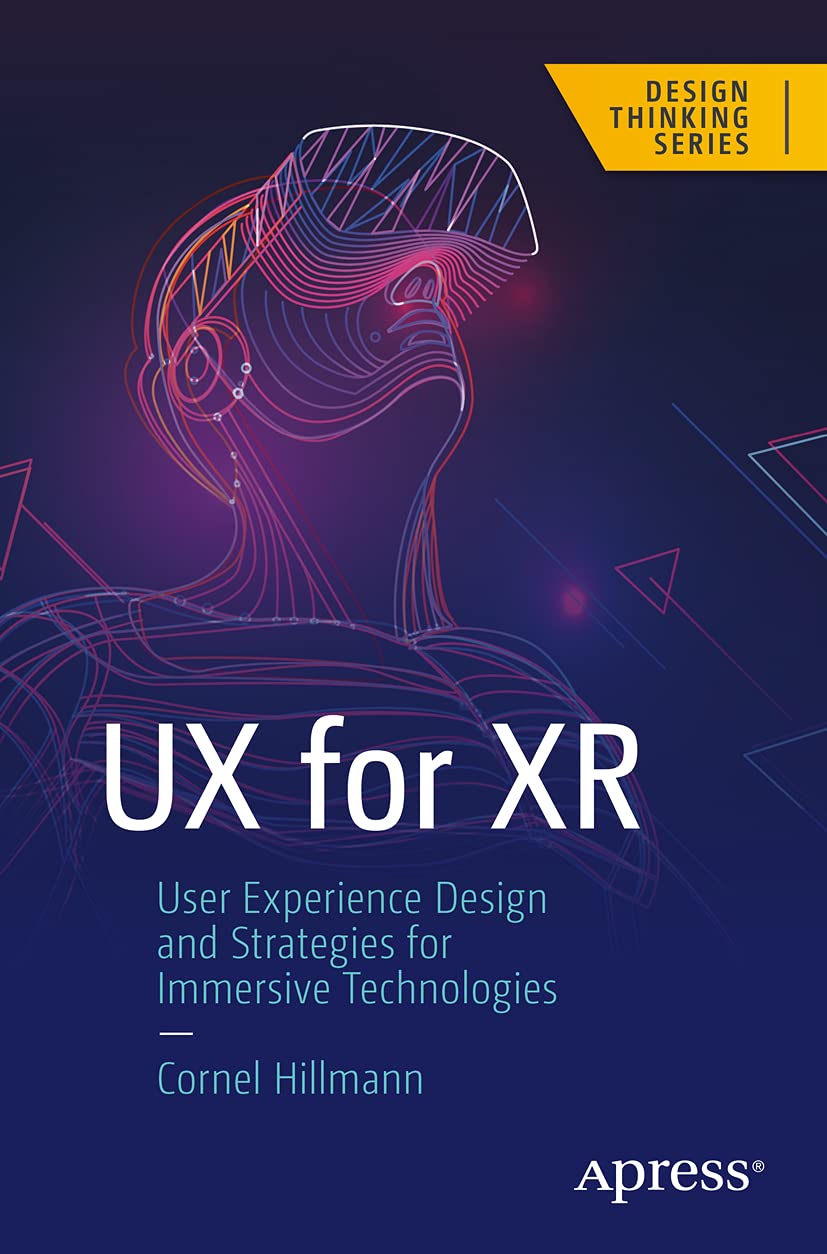
Image: Front cover of the "UX for XR: User Experience Design and Strategies for Immersive Technologies" book. The cover features a stylized graphic representing immersive technology concepts.
Setup and Initial Handling
Upon receiving your copy of "UX for XR", carefully remove it from its packaging. Inspect the book for any shipping damage. This paperback edition is designed for portability and ease of reading.
- Unpacking: Gently remove any protective wrapping.
- Initial Inspection: Check the binding, pages, and cover for any manufacturing defects or damage.
- Storage: Store the book in a dry place, away from direct sunlight and extreme temperatures, to preserve its quality.
Operating and Content Utilization
This book is intended for UX designers, consultants, strategists, XR developers, and media professionals seeking to understand and apply UX principles in extended reality. To effectively utilize the content:
- Sequential Reading: For a foundational understanding, it is recommended to read the chapters in sequence, as concepts build upon each other.
- Focused Study: If you are familiar with some XR concepts, you may focus on specific chapters relevant to your current learning objectives, such as 3D Interaction Design or UX research techniques for XR.
- Practical Application: The book emphasizes practical examples and case studies. Consider how the principles discussed can be applied to your own projects or areas of interest.
- Referencing: Use the book as a reference guide for specific topics related to UX in XR environments.
- Series Context: This book is part of the "Design Thinking" series. Exploring other books in the series may provide additional context and broader design principles.
Key learning outcomes include exploring challenges and opportunities in XR design, understanding spatial interaction, examining sensory input beyond the screen, working with 3D Interaction Design, and applying UX research techniques for the XR space.
Maintenance and Care
Proper care will ensure the longevity and readability of your book:
- Handling: Turn pages gently to avoid tearing. Avoid folding pages or dog-earing them; use a bookmark instead.
- Cleaning: For dust, gently wipe the cover with a dry, soft cloth. Avoid using liquids or abrasive cleaners.
- Protection: Keep the book away from food and drinks to prevent spills and stains.
- Binding: Do not force the book open flat, especially new copies, as this can damage the spine.
Troubleshooting
While efforts are made to ensure high-quality production, occasional issues may arise. Here are some common concerns and potential solutions:
| Issue | Solution |
|---|---|
| Illegible Illustrations/Small Text in Print Edition | Some readers have reported difficulty viewing illustrations or small text in the print edition due to size or print quality. If this significantly impacts your reading experience, consider acquiring the digital (eBook) version, which often allows for zooming and clearer display of graphics. |
| Damaged Pages/Binding | If your book arrived with significant damage, please contact the retailer or publisher (Apress) for a replacement or refund. |
| Content Clarity/Understanding | If you find certain concepts unclear, consider re-reading the section, consulting additional resources on UX or XR, or engaging with online communities focused on these topics. |
Specifications
| Feature | Detail |
|---|---|
| Publisher | Apress |
| Publication Date | June 13, 2021 |
| Edition | First Edition |
| Language | English |
| Print Length | 280 pages |
| ISBN-10 | 1484270193 |
| ISBN-13 | 978-1484270196 |
| Item Weight | 14.4 ounces |
| Dimensions | 6.1 x 0.64 x 9.25 inches |
| Series | Design Thinking (Part of a 10-book series) |
Warranty and Support
As a published book, "UX for XR" does not typically come with an explicit product warranty in the traditional sense. However, if you encounter issues such as manufacturing defects (e.g., missing pages, incorrect binding), please contact the publisher, Apress, or your point of purchase for assistance regarding returns or replacements.
For academic or technical support related to the content, you may be able to find resources or contact information through the publisher's website or the author's professional channels, if available.
About the Author
Cornel Hillmann is a media designer and CG artist with over 20 years of experience across media, entertainment, advertising, and design industries. His portfolio includes collaborations with notable brands such as Panasonic, Jaguar, The Future is Wild, The Singapore International Film Festival, and Razor. Cornel has delivered masterclasses on immersive media post-production, advanced 3D, VR, and media design courses at Limkokwing University. He is also the author of "Unreal for Mobile and Standalone VR" (Apress, 2019).