Introduction
This manual serves as a guide to the comprehensive text, Control System Technology by C. J. Chesmond. It is designed for engineering students and qualified engineers seeking a thorough understanding of control system technology. The book bridges the gap between theoretical control analysis and practical engineering applications, providing a balanced and detailed coverage of the field.
The content is structured to be clearly understood, with generous illustrations and line diagrams to aid comprehension. It assumes a foundational knowledge in electrical and electronic circuits, components, elementary mechanics, thermodynamics, and fluid dynamics.
Overview of Content
The book provides an extensive survey of various aspects of control system technology. Key areas covered include:
- Transducers: A wide-ranging survey, including displacement, reference, velocity, strain, force, torque, acceleration, load, and tension transducers.
- Servomechanisms and Process Control Systems: Detailed emphasis on their principles and applications.
- Signal Conditioning and Data Conversion: Comprehensive treatment of these essential topics.
- System Construction, Testing, and Commissioning: Important practical aspects of control systems.
- Amplifiers and Final Control Elements: Examination of electric, hydraulic, and pneumatic amplifiers, flow control valves, actuators, and positioners.
- Computer Interfacing and On-Stream Analysers: Coverage of their increasing importance in modern control engineering.
- Control System Performance: Discussions on performance evaluation and commissioning.
- Experimental Testing: Guidance on testing plant, system elements, and complete systems.
Image: Front cover of the "Control System Technology" textbook. This image displays the title and author, providing a visual reference for the publication.
Key Concepts and Terminology
The book begins by establishing a clear foundation with classifications, terminology, and definitions crucial for understanding control systems. It then delves into the specifics of various components:
- Transducer Types: Detailed explanations of how different physical quantities (displacement, force, temperature, etc.) are converted into measurable signals.
- Control System Classification: Understanding the different types of control systems, including natural control systems and generalized single-loop continuous feedback control systems.
- Amplification Principles: The role and function of electric, hydraulic, and pneumatic amplifiers in control loops.
- Data Conversion: The processes involved in converting analog signals to digital and vice-versa for computer interfacing.
Applications in Engineering
The text emphasizes practical applications, ensuring that readers can apply theoretical knowledge to real-world engineering problems. It covers:
- Industrial Process Control: How control systems are implemented in manufacturing and industrial settings.
- Automation: The integration of computer systems for automated control and analysis.
- System Design and Implementation: Practical considerations for designing, building, and deploying control systems.
How to Use This Book (Setup)
To maximize your learning from Control System Technology, consider the following approach:
- Review Prerequisites: Ensure you have a basic understanding of electrical and electronic circuits, components, elementary mechanics, thermodynamics, and fluid dynamics.
- Sequential Reading: The book is structured logically, building concepts progressively. It is recommended to read chapters in sequence to fully grasp the material.
- Utilize Diagrams: Pay close attention to the generous illustrations and line diagrams, as they are integral to understanding complex concepts.
- Practice and Application: Where applicable, try to relate the theoretical concepts to practical examples or problems you encounter in your studies or work.
Effective Study (Operating)
Engage with the material actively to enhance your comprehension:
- Note-Taking: Summarize key definitions, principles, and methodologies in your own words.
- Concept Mapping: Create visual maps to connect related concepts, especially for transducers, amplifiers, and control loops.
- Cross-Referencing: If a concept is unclear, refer back to earlier sections or external resources on the assumed prerequisite knowledge.
Book Care (Maintenance)
To ensure the longevity of your copy of Control System Technology:
- Storage: Store the book in a dry, cool place away from direct sunlight to prevent page yellowing and binding damage.
- Handling: Handle with clean hands to avoid smudges and stains. Avoid folding pages or forcing the spine open excessively.
- Protection: Consider using a book cover if you frequently transport the book.
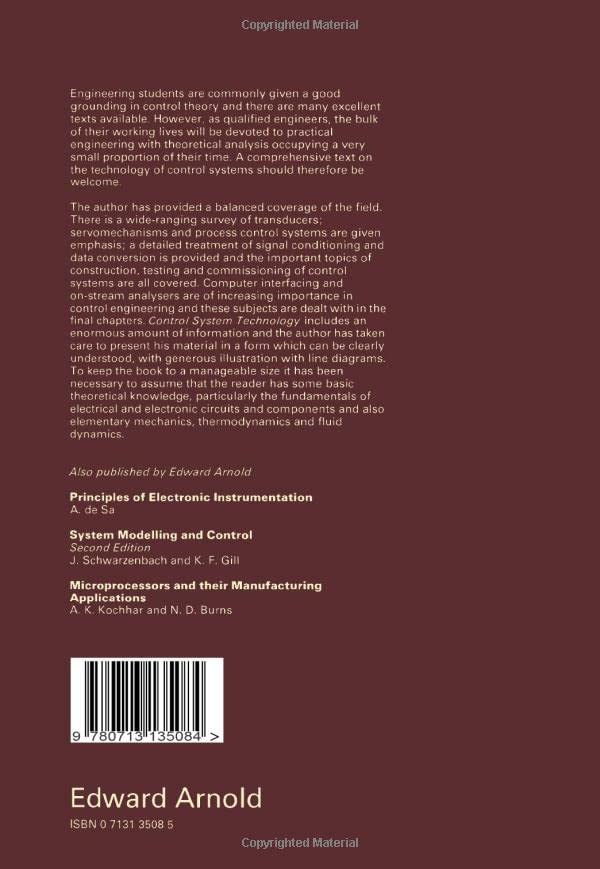
Image: Back cover of the "Control System Technology" textbook. This image includes the ISBN barcode and additional descriptive text about the book's content.
Troubleshooting Understanding
If you encounter difficulties in understanding certain concepts:
- Revisit Fundamentals: The book assumes basic knowledge in several areas. If a concept is challenging, review the foundational principles of electrical engineering, mechanics, or thermodynamics.
- Consult External Resources: Supplement your reading with other textbooks, academic papers, or online tutorials on specific topics.
- Seek Clarification: Discuss difficult sections with peers, instructors, or mentors.
Specifications
| Attribute | Detail |
|---|---|
| Title | Control System Technology |
| Author | C. J. Chesmond |
| Publisher | Arnold (Edward Arnold) |
| Publication Date | January 1, 1982 |
| Language | English |
| Print Length | 480 pages |
| ISBN-10 | 0713135085 |
| ISBN-13 | 978-0713135084 |
| Item Weight | 2.12 pounds |
| Dimensions | 7.25 x 1.09 x 10.5 inches |
Warranty and Support
As a textbook, this product does not typically come with a traditional warranty. For academic support or inquiries regarding the content, it is recommended to:
- Publisher Contact: For publishing-related inquiries, contact Edward Arnold, the publisher.
- Academic Institutions: Consult with your university or college library, professors, or academic support services for assistance with the subject matter.
- Online Forums: Participate in engineering or control systems forums for community support and discussion.