
1. Introduction to SNMPv3 and Network Management
This guide offers a comprehensive approach to understanding and implementing SNMPv3 for modern network management. It combines theoretical foundations with practical deployment strategies, focusing on securing information systems and preparing for future network challenges. The book addresses the complexities of SNMPv3 by providing clear explanations and actionable insights for network managers and software developers.
Key areas covered include the new SNMPv3 framework, its security features such as authentication, encryption, and access control, and practical techniques for utilizing RMON2 to gain deep insights into network traffic. It also explores the use of Cisco MIBs for effective network management.
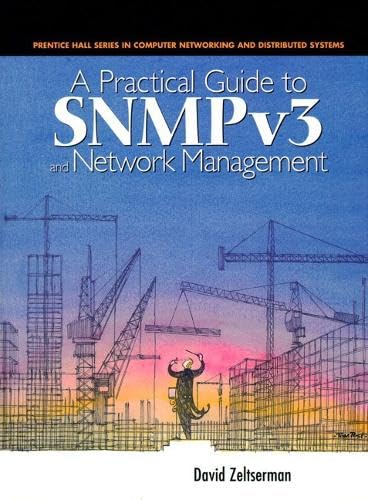
Figure 1: Cover of the "Practical Guide to SNMPv3 and Network Management" book. The illustration depicts a conductor leading an orchestra amidst a backdrop of network infrastructure under construction, symbolizing the orchestration of complex network systems.
2. Core Concepts and Frameworks
This section details the fundamental concepts of SNMP, progressing from earlier versions to the advanced features of SNMPv3.
2.1. SNMPv1 and SNMPv2 Basics
The manual begins by describing SNMPv1 and SNMPv2, covering basic data types for management information and textual conventions for abstract data types. It outlines the rules for naming and defining managed objects, along with the operations defined for SNMPv1 and extensions for SNMPv2. Emphasis is placed on how management information represented by MIB-II can be utilized by network managers.
2.2. SNMPv3 Framework
SNMPv3 introduces a robust framework, new textual conventions, and an updated message format. The book explains the logical subsystems that constitute an SNMPv3 architecture and the abstract service interfaces used between these subsystems. It focuses on practical applications that can run within an SNMP entity.
2.3. RMON2 for Network Understanding
RMON2 is presented as a critical advancement in network management, enabling understanding of both network-layer and application-layer traffic. The guide explains how RMON2 facilitates insight into protocol usage and conversations, aiding network managers in planning for growth and optimizing client-server communications.
3. Practical Implementation and Configuration
This section provides guidance on configuring and deploying SNMPv3 and related technologies.
3.1. Configuring SNMPv3 Features
The manual provides instructions on configuring SNMPv3 for generating notifications, proxy forwarding, authentication, security, and access control. It details how these features are configured using specific SNMPv3 MIBs. The view-based access control model is also explained, along with its configuration using new SNMPv3 MIBs.
3.2. Utilizing RMON2
Instructions are provided on how to configure RMON2 and access its data tables. The book suggests various RMON2 applications that can be developed to leverage its capabilities for network monitoring and analysis.
3.3. Coexistence and Cisco MIBs
The guide examines coexistence issues between different SNMP versions (SNMPv1, SNMPv2, and SNMPv3). It also explores several Cisco Private MIBs, demonstrating how they can be used for specific network management tasks.
4. Pseudocode Notation
Throughout the book, pseudocode is used to illustrate the logic for configuring and accessing SNMPv3 and RMON2 MIB tables. The pseudocode format is a blend of C and Tcl, with elements of Java where appropriate. All pseudocode examples are presented in a courier font for clarity and are designed to be descriptive and easily understandable.
foreach inst in ifTable {
print ifSpeed.inst
}
This example demonstrates iterating through the ifTable to print the ifSpeed value for each instance.
5. Specifications
| Attribute | Detail |
|---|---|
| Publisher | Prentice Hall |
| Publication Date | June 15, 1999 |
| Edition | First Edition |
| Language | English |
| Print Length | 337 pages |
| ISBN-10 | 0130214531 |
| ISBN-13 | 978-0130214539 |
| Item Weight | 1.9 pounds |
| Dimensions | 7.5 x 1.25 x 9.75 inches |
6. About the Author
David Zeltserman is a Network Management Architect with extensive experience in developing networking devices and management software for companies such as DEC, Cisco, and 3Com. He is also the co-author of "Building Network Management Tools with Tcl/Tk" and "The Complete Tcl/Tk Training Course."