Introduction
This manual is designed to assist students and educators in effectively utilizing the Glencoe Physics: Principles & Problems Student Edition textbook. It provides guidance on the book's structure, content, and how to maximize its educational value for developing a strong foundation in physics.
Getting Started
To begin your study of physics with this textbook, familiarize yourself with its overall layout. The book is structured to build conceptual understanding alongside mathematical problem-solving skills.

Figure 1: Front Cover. This image displays the front cover of the Glencoe Physics: Principles & Problems Student Edition textbook, featuring the title, publisher's logo, and illustrative physics concepts such as lightning, a burning match, a person running, and a Newton's cradle.
It is recommended to review the preface and introduction sections of the textbook for an overview of its pedagogical approach and features. Ensure you have the necessary foundational knowledge in algebra, geometry, and trigonometry, as these are prerequisites for understanding the mathematical applications within the text.
Using the Textbook
The textbook is organized into chapters, each focusing on specific physics principles. Each chapter typically includes:
- Conceptual Explanations: Clear descriptions of physics concepts.
- Example Problems: Step-by-step solutions demonstrating how to apply principles.
- Practice Problems: Opportunities to apply learned concepts independently.
- Chapter Reviews: Summaries and questions to reinforce understanding.

Figure 2: Back Cover with Contents. This image displays the back cover of the textbook, which includes a detailed table of contents listing 30 chapters, ranging from "A Physics Toolkit" to "Nuclear Physics." It also shows the authors and educational partners.
It is recommended to read each section thoroughly, paying close attention to diagrams and illustrations. Work through the example problems before attempting the practice problems. Utilize the end-of-chapter questions to assess your comprehension.
Care and Maintenance
To ensure the longevity of your textbook, follow these guidelines:
- Store the book in a dry environment, away from direct sunlight and extreme temperatures.
- Avoid bending or creasing the spine excessively.
- Use bookmarks instead of folding pages.
- Keep the book away from liquids and food to prevent stains and damage.
- Handle with clean hands to preserve the pages and cover.
Problem Solving and Support
If you encounter difficulties understanding concepts or solving problems:
- Re-read the relevant sections and review example problems.
- Consult supplementary materials or online resources provided by the publisher.
- Discuss challenging topics with peers or instructors.
Additional support and resources may be available online:
- physicspp.com (Official companion website for Physics: Principles and Problems)
- glencoe.com (Glencoe publisher's website for educational resources)
Specifications
| Publisher | McGraw-Hill/Glencoe |
| Publication Date | May 14, 2004 |
| Edition | 9th ed. |
| Language | English |
| Print Length | 943 pages |
| ISBN-10 | 0078458137 |
| ISBN-13 | 978-0078458132 |
| Item Weight | 4.97 pounds |
| Dimensions | 8.7 x 1.4 x 11.16 inches |
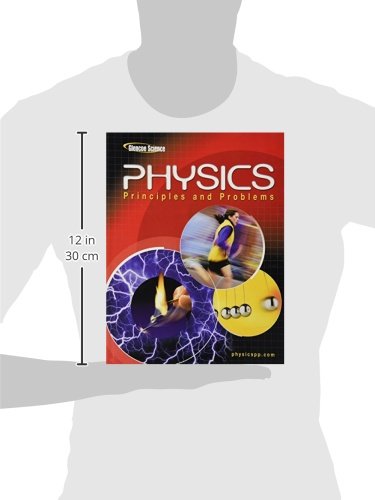
Figure 3: Textbook Dimensions. This image illustrates the physical size of the Glencoe Physics: Principles & Problems textbook, showing it held by hands with measurement markings indicating its approximate height of 12 inches (30 cm).
Warranty and Returns
Textbooks typically do not come with a manufacturer's warranty in the traditional sense. However, if purchased from a retailer, standard return policies may apply. For example, Amazon's return policy for this product indicates a 30-day return window from the date of receipt for eligible returns. Please refer to the specific retailer's return policy at the time of purchase for detailed information regarding returns or exchanges.
Additional Resources
For further information regarding the content, authors (Paul Zitzewitz, McGraw-Hill/Glencoe), or other educational materials, please visit the publisher's official websites or contact their customer support channels.


